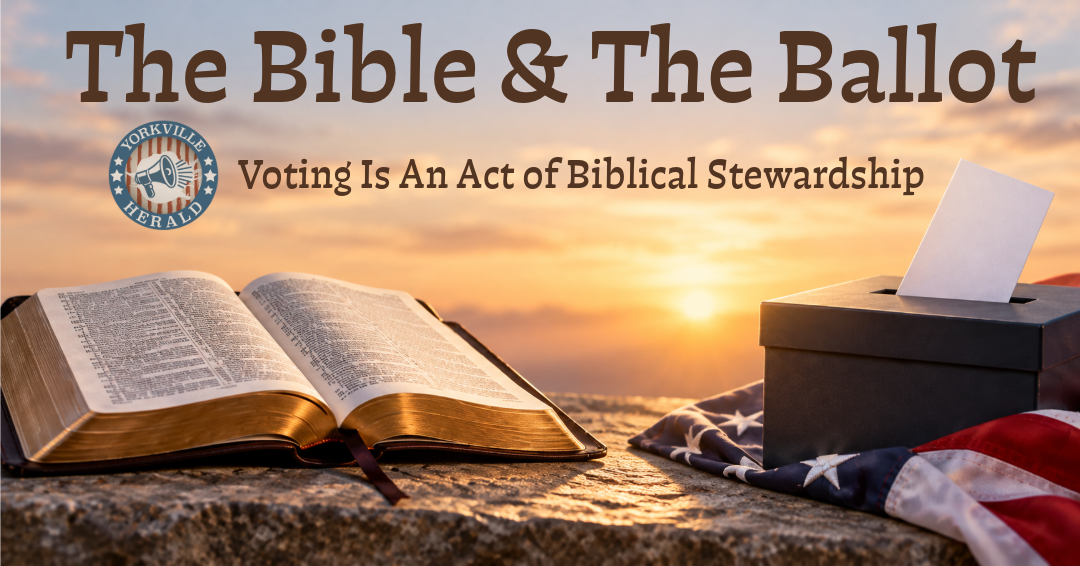
Voting is an Act of Biblical Stewardship
Opinion Piece | Michael Krempski
Every election season, Americans are inundated with campaign signs, political advertisements, debates, and promises. In the midst of the noise, voting is often reduced to a partisan exercise or treated as little more than a civic duty. Yet for those who understand that our rights come from God and that government exists to serve the people, voting carries a deeper meaning.
Voting is not simply a political act. It is an act of stewardship.
From the opening pages of Scripture, God entrusted mankind with responsibility. In Genesis 1:28, God blessed humanity and commanded them to "be fruitful and multiply, and fill the earth and subdue it," giving mankind dominion over His creation. This first stewardship mandate established a timeless principle: God entrusts responsibilities to people and holds them accountable for how they exercise them.
The same principle applies to civil government.
The Bible teaches that government is not merely a human invention, but an institution established by God. The Apostle Paul wrote:
"Let every person be subject unto the higher powers. For there is no power but of God: the powers that be are ordained of God." (Romans 13:1)
Civil authority ultimately belongs to God. He is the author of government. While nations may structure their governments differently, all legitimate authority derives from Him. In monarchies, authority rests with kings. In dictatorships, authority is concentrated in a ruling elite. But in the American constitutional republic, authority is vested in the people themselves.
This truth is one of America's most unique contributions to political history.
When Jesus instructed His listeners to "render unto Caesar" (Matthew 22:21) what belonged to Caesar, there was a literal Caesar sitting on a throne. In America, there is no king. There is no emperor. There is no permanent ruling class. The people are sovereign. The people delegate authority to public servants through elections, and those servants remain accountable to the people.
In America, the place once occupied by Cesar is filled by the people themselves, and God’s people exercise that authority under the sovereignty of their King.
That reality elevates voting from a mere political preference to a sacred responsibility. Every ballot cast is an exercise of authority entrusted to the citizen by both the constitutional order and the providence of God.
America's founders understood this connection between self-government, morality, and responsibility.
In his Farewell Address, George Washington warned:
"Of all the dispositions and habits which lead to political prosperity, religion and morality are indispensable supports." ¹
Washington further observed:
"It is substantially true that virtue or morality is a necessary spring of popular government." ²
His concern was straightforward. A free people can govern themselves only when guided by virtue. Self-government ultimately requires self-discipline. Citizens who neglect their responsibilities gradually surrender their liberties to those willing to exercise power in their place.
Likewise, John Adams famously wrote:
"Our Constitution was made only for a moral and religious people. It is wholly inadequate to the government of any other." ³
Adams recognized that America's constitutional system was not designed to preserve liberty through laws alone. Freedom depends upon the character of the people. If citizens abandon virtue, no constitution, however well-written, can protect their liberties indefinitely.
Perhaps no Founder spoke more directly about voting itself than Samuel Adams, often called the Father of the American Revolution:
"Let each citizen remember at the moment he is offering his vote, that he is not making a present or a compliment to please an individual, or at least that he ought not so to do; but that he is executing one of the most solemn trusts in human society for which he is accountable to God and his country." ⁴
Those words ring just as true today as when they were written. A vote is not a gift. It is not a gesture of personal loyalty. It is not merely an expression of preference. It is a trust. Every citizen who enters the voting booth exercises authority that will affect families, communities, schools, churches, businesses, and future generations.
Similarly, John Jay, the first Chief Justice of the United States and co-author of the Federalist Papers, reminded Americans:
"Providence has given to our people the choice of their rulers, and it is the duty, as well as the privilege and interest, of our Christian nation to select and prefer Christians for their rulers." ⁵
This principle remains undeniable: citizens bear responsibility for the character and principles of the leaders they elect.
Scripture repeatedly emphasizes the importance of righteous leadership. Proverbs 29:2 declares:
"When the righteous are in authority, the people rejoice: but when the wicked beareth rule, the people mourn."
The Bible never calls God's people to political apathy. Rather, it calls them to wisdom, discernment, and faithful stewardship of whatever responsibilities God has placed before them.
This teaching becomes even more important when viewed through the lens of generations.
Every generation inherits blessings that it did not create. Americans today enjoy freedoms secured through the sacrifices of countless men and women who came before us. America’s founders gave their “Lives, Fortunes, and sacred Honor.” ⁶ They fought wars, built institutions, defended liberties, and passed down a constitutional system unlike any the world had ever seen.
Yet every generation must decide whether those blessings will endure.
The biblical principle of stewardship always carries accountability. Jesus taught in Luke 12:48:
"For unto whomsoever much is given, of him shall be much required."
Americans have been given much. We possess the freedom to worship, speak, assemble, petition our government, and influence public policy through our representatives, and the ballot box. Many throughout history have never enjoyed such privileges.
To neglect voting out of apathy is not stewardship.
To cast a vote without careful consideration is not stewardship.
To ignore the character, principles, and policies of those seeking office is not stewardship.
Stewardship requires citizens to seek truth, weigh issues carefully, pray for wisdom, and exercise the authority entrusted to them with humility and conviction.
This does not mean we must agree with every position a candidate holds, nor does it mean faithful citizens will arrive at identical conclusions on every policy question. Reasonable and principled disagreements will always exist in a free society. It does mean, however, that voting should be approached as a serious responsibility rather than a casual preference, exercised with careful thought, prayerful consideration, and an eye toward the long-term good of the community and the nation.
The central question is not, "What benefits me today?"
The better question is, "Which choice best advances justice, protects liberty, strengthens families, and promotes the common good for future generations?"
The Founders believed that the survival of self-government depended upon an engaged and moral citizenry. Scripture teaches that God entrusts responsibilities to His people and expects faithful stewardship. In America, those two truths converge in a unique and powerful way.
Because government is ordained by God, because the people are the sovereign authority within our constitutional system, and because each vote helps shape the future inheritance of our children and grandchildren, voting is far more than a political right.
It is a moral responsibility.
It is a civic duty.
And for every generation blessed to live in liberty, it is an act of biblical stewardship.
Endnotes
¹ Washington, George. Washington’s Farewell Address. Prepared by the United States Senate Historical Office, United States Senate, https://www.senate.gov/artandhistory/history/resources/pdf/Washingtons_Farewell_Address.pdf. Accessed 15 Oct. 2026.
² Washington, George. Washington’s Farewell Address. Prepared by the United States Senate Historical Office, United States Senate, https://www.senate.gov/artandhistory/history/resources/pdf/Washingtons_Farewell_Address.pdf. Accessed 15 Oct. 2026.
³ Adams, John. “From John Adams to Massachusetts Militia, 11 October 1798.” Founders Online, National Archives, 11 Oct. 1798, https://founders.archives.gov/documents/Adams/99-02-02-3102. Accessed 15 Oct. 2026.
⁴ Samuel Adams in the Boston Gazette, April 16, 1781, The Writings of Samuel Adams, ed. Harry Alonzo Cushing (New York: G.P. Putnam’s Sons, 1907), IV:256.
⁵ John Jay, The Correspondence and Public Papers of John Jay, ed. Henry P. Johnston (New York: G.P. Putnams Sons, 1890), IV:365.
⁶ “Declaration of Independence: A Transcription.” National Archives, U.S. National Archives and Records Administration, https://www.archives.gov/founding-docs/declaration-transcript. Accessed 15 Oct. 2026.
⁷ The Holy Bible.