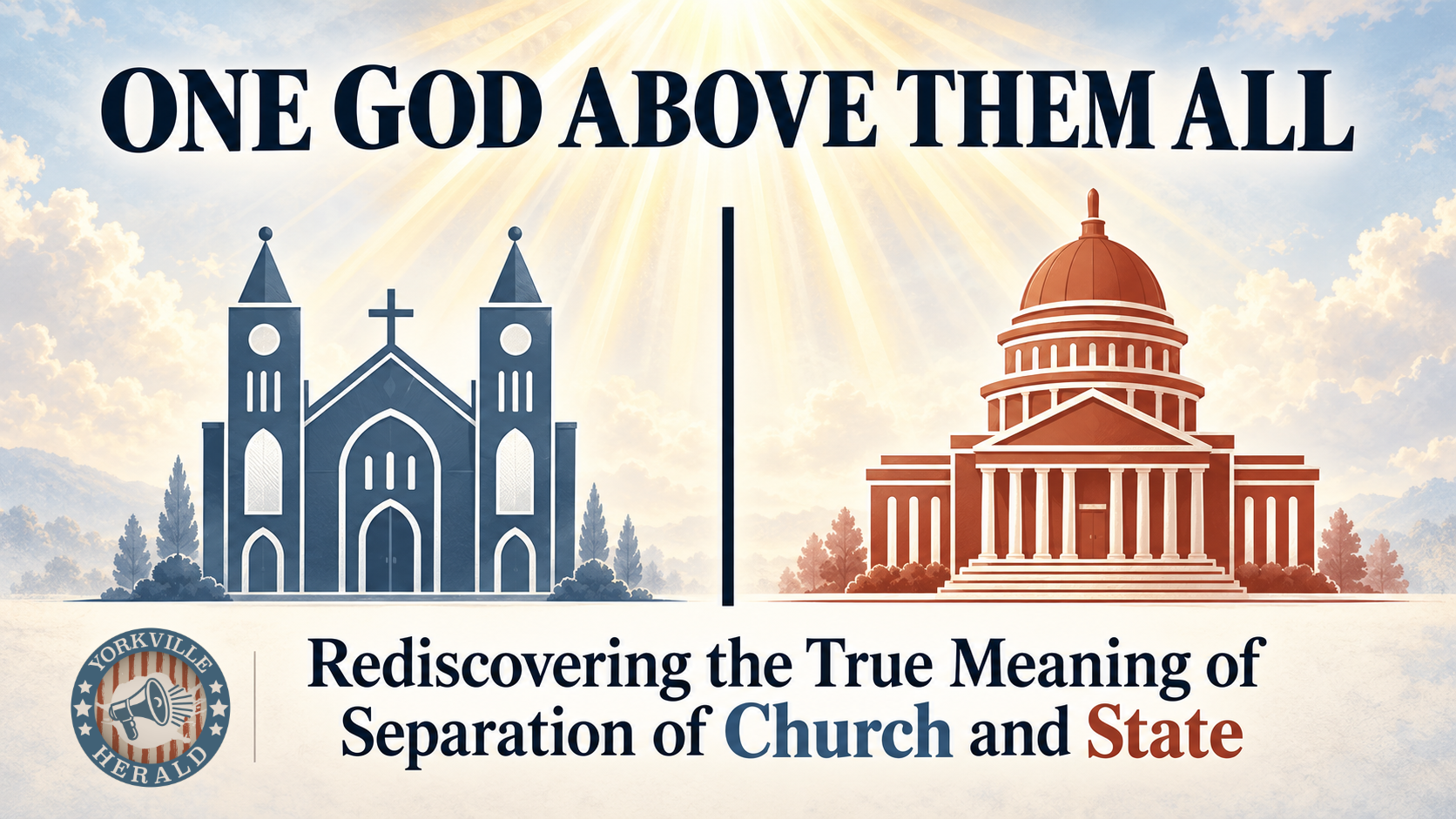
One God Above Them All
Rediscovering the True Meaning of Separation of Church and State
Opinion Piece By | Molly Krempski
For a very long time, Americans have been taught to think about the separation of church and state in a particular way. The phrase has often been understood to mean that religion belongs in the private sphere and that government, in order to remain constitutional, must operate as though God is absent. But that understanding deserves another look.
To understand why, it is helpful to go much further back than the American founding, to ancient Israel before Israel had kings. God was their King, but Israel was not without human government. Judges administered justice. Elders governed. Priests were entrusted with worship and religious instruction. Prophets called the people and their leaders back to faithfulness.
These were different offices with different responsibilities. A judge was not a priest. A priest was not a civil magistrate. There was separation of duties and jurisdictions, but there was never separation from God among any jurisdiction.¹ That distinction matters because the existence of separate institutions did not mean that any of those institutions operated independently of God’s authority.
When Israel later demanded a king so that they could be “like all the nations,” God declared, “They have rejected me, that I should not reign over them.” ² Israel was not without government. It already had laws, judges, and elders. The problem was not the existence of civil authority, but the people’s desire for an earthly king like those of the surrounding nations, rather than continuing to recognize God as their King.
This history was not foreign to America’s founding generation. Thomas Paine discussed it directly in Common Sense, describing Israel before monarchy as “a kind of Republic, administered by a judge and the elders of the tribes.” He went on to observe that Israel had no earthly king during that period because the Lord remained above them.³
In a remarkable sense, America reversed Israel’s later error. Israel demanded an earthly king so that the nation could become like the nations around it. America rejected an earthly king and established a republic in which rulers themselves would be bound by law. That did not mean the founders created a nation in which God had no place in public life.
Our Declaration of Independence says that human beings are endowed by their Creator with unalienable rights and that governments are instituted among men to secure those rights. The government does not create those rights. It exists because those rights already belong to the people.⁴
The Illinois Constitution is even more explicit. Its preamble begins with the People of Illinois declaring themselves “grateful to Almighty God for the civil, political and religious liberty which He has permitted us to enjoy” and “seeking His blessing upon our endeavors.” ⁵ Our Pledge describes us as “one Nation under God.” Our national motto is “In God We Trust.” ⁶
These things raise an obvious question. If separation of church and state means that civil government must be separated from God, how can these expressions exist within our constitutional tradition? Perhaps we have misunderstood what separation of church and state is supposed to mean.
There is also an important modern legal development that should cause Americans to revisit some of the assumptions that became deeply embedded in public life during the last several decades. In 2022, the United States Supreme Court decided Kennedy v. Bremerton School District. In that decision, the Court said that it had “long ago abandoned” the Lemon test and its endorsement-test offshoot. Instead, the Court explained that the Establishment Clause must be interpreted by reference to our nation’s “historical practices and understandings.” ⁷
That did not abolish the separation of church and state. It presents us with an opportunity to understand it correctly.
The separation of church and state establishes distinct spheres of authority, each with its own responsibilities and limitations. Civil government is entrusted with the administration of law and public affairs, while the Church is entrusted with spiritual leadership, worship, and religious instruction. Neither institution should usurp the authority of the other, but both remain accountable to a higher authority than themselves.
Judges should judge. Pastors should pastor. Legislators should legislate. Different offices. Different jurisdictions. But one God above them all.
That distinction is enormously important because institutional separation and spiritual separation are not the same thing. The constitutional prohibition against establishing religion does not require public officials to behave as though God does not exist. Nor does religious liberty depend upon stripping every acknowledgment of God from the public square. Our own historical documents make such a conclusion difficult to reconcile with the political tradition that produced them.
The American constitutional system divides powers precisely because human power must be limited. Presidents have limits. Governors have limits. Legislatures have limits. Courts have limits. Every human institution has a jurisdiction beyond which it should not go. Acknowledging an authority higher than government does not diminish that principle. It reinforces it.
When the Declaration recognizes a Creator who endows human beings with rights, it places those rights beyond the rightful reach of government. When the Illinois Constitution expresses gratitude to Almighty God for liberty and seeks His blessing, it acknowledges that government is not the ultimate source of that liberty. That is very different from creating a state church or giving clergy the power to govern. It is the recognition that civil government itself is not God.
Post-Lemon America has an opportunity to recover a distinction that has been blurred for generations. Separation of church and state need not mean separation of government from God. It can mean what constitutional government has always required - proper boundaries between institutions, protection of religious liberty, and limitations on the exercise of civil and ecclesiastical power.
Public officials do not have to become pastors. Churches do not have to become governments. But neither must government pretend that acknowledging God is somehow foreign to the American constitutional tradition. We are free to acknowledge Him, seek His wisdom, and submit ourselves to Him while remaining within the proper constitutional duties of civil government.
Different offices. Different jurisdictions. Different responsibilities. But one God above them all.
And when we begin to understand that distinction again, perhaps we will also begin to recover something our nation desperately needs - the humility to recognize that government was never intended to be our highest authority, and that no society can separate itself from the Source of its liberty indefinitely without consequences.
When we begin to acknowledge God, seek His wisdom, and rightly order our public institutions under Him again, our state and our nation will begin to heal.

Molly Krempski
Sources and References
¹ Civil Government and Religious Offices in Ancient Israel. Exodus 18:13–26 describes
Moses appointing judges to administer justice. Deuteronomy 16:18–20 establishes judges and officers. Deuteronomy 17:8–13 distinguishes priestly and judicial responsibilities. Numbers 18:1–7 describes the duties entrusted to the priesthood.
https://www.biblegateway.com/passage/?search=Exodus%2018&version=KJV
https://www.biblegateway.com/passage/?search=Deuteronomy%2016-17&version=KJV
https://www.biblegateway.com/passage/?search=Numbers%2018&version=KJV
² Israel’s Rejection of God as King. 1 Samuel 8:4–7 records Israel’s demand for a king and God’s response to Samuel that the people had rejected His reign.
https://www.biblegateway.com/passage/?search=1%20Samuel%208&version=KJV
³ Thomas Paine, Common Sense (1776). In the section criticizing monarchy, Paine describes ancient Israel’s government before kingship as a republic administered by judges and tribal elders.
https://press-pubs.uchicago.edu/founders/documents/v1ch4s4.html
⁴ The Declaration of Independence (July 4, 1776). The Declaration identifies the Creator as the source of unalienable rights and explains that governments are instituted to secure those rights.
https://www.archives.gov/founding-docs/declaration-transcript
⁵ Illinois Constitution of 1970, Preamble. The preamble acknowledges Almighty God as the source of civil, political, and religious liberty and seeks His blessing upon the endeavors of the people of Illinois.
https://www.ilga.gov/commission/lrb/conp.htm
⁶ The Pledge of Allegiance and National Motto. Title 4, Section 4 of the United States Code establishes the wording of the Pledge of Allegiance, including “one Nation under God.” Title 36, Section 302 establishes “In God We Trust” as the national motto.
https://www.law.cornell.edu/uscode/text/36/302
⁷ Kennedy v. Bremerton School District, 597 U.S. 507 (2022). The Supreme Court stated that it had abandoned the Lemon test and its endorsement-test offshoot, directing Establishment Clause analysis toward historical practices and understandings. See pages 22–23 of the majority opinion.