Should America Screen Immigrants for Allegiance to Its Biblical Constitutional Order?
Opinion Piece By | Molly Krempski
As immigration continues to reshape American life, one question deserves renewed public debate: Should the United States more carefully screen prospective immigrants for allegiance to America’s biblical constitutional order before granting them entry? The question is often dismissed before it is even considered, especially when critics label it a “religious test.” But that phrase can obscure the real issue. America does not need to persecute private religious belief, nor should it deny entry to someone merely because he was born into another culture or raised in another religion. The more serious question is whether an applicant intends to live peacefully under American law, or whether he owes his highest civil loyalty to a competing religious, political, or ideological system that rejects America’s legal foundation.
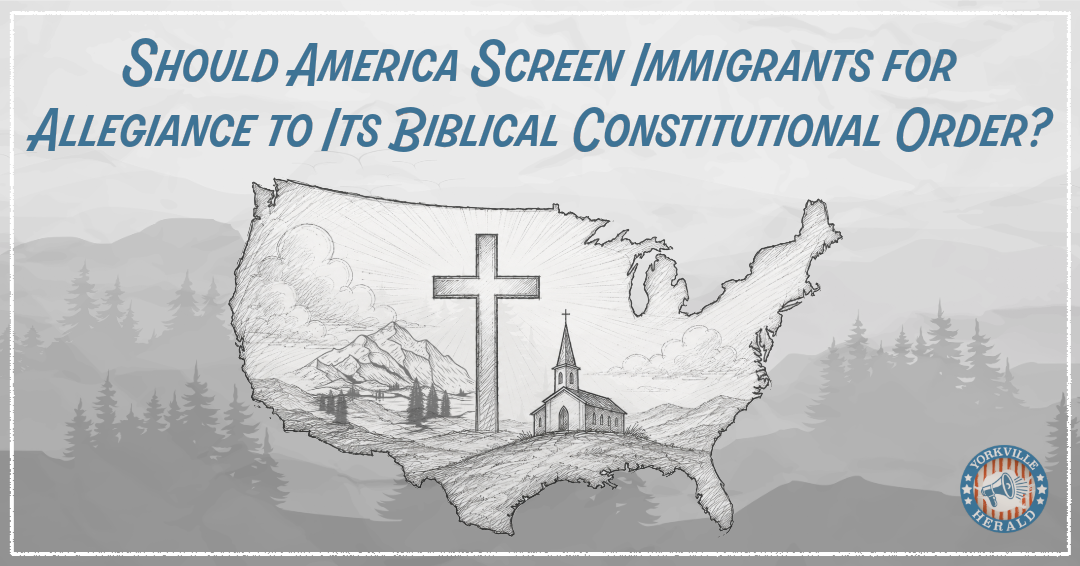
From its inception, America’s legal and moral order was shaped by biblical principles: the rule of law, ordered liberty, equal justice, property rights, human dignity, covenant responsibility, and the recognition that civil government itself is under a higher moral authority. That foundation does not mean every person in America must be a Christian in order to live here. But it does mean that America’s system of liberty depends on certain moral and legal assumptions. A person may worship privately according to conscience, but no person should be admitted into the country for the purpose of advancing a rival legal order, subverting constitutional government, or weakening the civil framework that protects liberty for everyone.
The Supreme Court has long recognized that immigration is different from ordinary domestic policy. In cases such as Kleindienst v. Mandel, Fiallo v. Bell, and Trump v. Hawaii, the Court affirmed that the admission and exclusion of foreign nationals is a fundamental sovereign power largely entrusted to Congress and the executive branch. [1][2][3] That does not give the government unlimited moral wisdom, nor does it mean every immigration policy is good. But it does mean the political branches have broad authority to decide who may enter the United States and under what conditions, especially when national security, foreign policy, or public order are involved.
That legal principle matters because the debate should not be reduced to whether America may ask questions about religion. The better question is whether America may ask questions about allegiance, conduct, ideology, and willingness to obey American law above any competing authority. A policy that simply asks, “What religion are you?” would be both crude and legally vulnerable. But a policy that asks whether an applicant supports terrorism, religious coercion, forced marriage, polygamy, punishment of apostasy, antisemitic violence, or the overthrow of constitutional government is not religious persecution. It is basic national self-preservation.
Federal law already reflects this distinction. Under 8 U.S.C. § 1182, aliens may be found inadmissible for a wide range of reasons involving crime, fraud, terrorism, espionage, sabotage, public safety, and threats to the United States. [4] The statute also bars people connected to terrorist activity, those who endorse or support terrorism, and immigrants affiliated with Communist or other totalitarian parties, subject to certain exceptions. [4] The same section even makes inadmissible an immigrant who is coming to the United States to practice polygamy. [4] These provisions show that American immigration law has never been limited to paperwork, employment eligibility, and family relationships alone. It has always included judgments about whether certain beliefs, affiliations, practices, or intentions are incompatible with the public order of the United States.
Visa law also gives the government room to ask detailed questions during the screening process. Under 8 U.S.C. § 1202, visa applicants may be required to submit information and documentation as part of the application process, and consular officers may interview applicants and examine whether they qualify for admission. [5] That does not mean every question would automatically be lawful or wise, but it does show that the immigration system is already built around inquiry, investigation, and judgment. The issue is not whether the government may screen applicants. The issue is what kind of screening best protects the country while staying within constitutional and statutory limits.
Naturalization law points in the same direction. A person seeking citizenship must demonstrate attachment to the principles of the Constitution and a favorable disposition toward the good order and happiness of the United States. [6] The oath of allegiance also requires a new citizen to support the Constitution, renounce prior political allegiance, and defend the Constitution and laws of the United States against enemies foreign and domestic. [7] If those standards are appropriate before granting citizenship, then Americans have every reason to ask whether similar principles should play a stronger role before granting legal entry or long-term residence.
This does not mean Congress or the executive branch has a blank check to discriminate however it wishes. Federal law provides that, in the issuance of immigrant visas, a person may not be given preference, priority, or discrimination because of race, sex, nationality, place of birth, or place of residence, subject to specific statutory exceptions. [8] That limitation matters. But it does not erase the government’s separate authority to screen for terrorism, unlawful conduct, totalitarian affiliations, fraud, threats to public safety, or refusal to live under American civil law. In other words, the legally stronger proposal is not a religious ban. It is a serious allegiance and public-order test.
The strongest immigration test, then, would not be a religious test in the narrow sense. It would be an allegiance test. It would ask whether the applicant recognizes the Constitution and laws of the United States as supreme in civil matters. It would ask whether the applicant rejects terrorism, religious coercion, political violence, and the use of foreign or religious legal systems to override American law. It would ask whether the applicant believes women, converts, Christians, Jews, religious minorities, and political dissenters are entitled to equal civil protection under American law. It would ask whether the applicant rejects any command, religious or otherwise, to subvert the constitutional order of this country.
These are not unreasonable questions. They are the minimum questions a serious nation should ask. Religious liberty can only survive inside a legal order strong enough to protect it. If America admits large numbers of people who reject the very principles that make religious liberty possible, then the country is not practicing compassion. It is failing in its duty to protect its own citizens and preserve its own constitutional inheritance.
This distinction is essential. Private worship is one thing. Importing a religious, ideological, or political movement that refuses assimilation and seeks dominance over American civil society is another. No nation is obligated to admit people who intend to use its freedoms against it. A person who comes to America in good faith, willing to obey its laws and respect the rights of others, should not be treated as an enemy merely because of his background. But a person who believes another authority must supersede the Constitution in civil life presents a different question altogether.
America does not need a policy of religious persecution. It needs a policy of constitutional self-preservation. The point is not to punish private conscience, but to defend the conditions that make liberty, justice, and ordered self-government possible. A nation has the right to decide whom it admits, and it has the responsibility to preserve the moral and legal order that made it free.
The question before America is not whether every immigrant comes from the same background, culture, or faith. The question is whether those seeking entry intend to join this nation in good faith, live under its Constitution, and respect the civil rights of their neighbors. A nation that refuses to defend its own foundations will eventually be ruled by someone else’s.

Molly Krempski
Endnotes
[1] Kleindienst v. Mandel, 408 U.S. 753. Supreme Court of the United States, 1972. Justia, https://supreme.justia.com/cases/federal/us/408/753/.
[2] Fiallo v. Bell, 430 U.S. 787. Supreme Court of the United States, 1977. Justia, https://supreme.justia.com/cases/federal/us/430/787/.
[3] Trump v. Hawaii, 585 U.S. 667. Supreme Court of the United States, 2018, https://www.supremecourt.gov/opinions/17pdf/17-965_h315.pdf.
[4] “8 U.S.C. § 1182 — Inadmissible Aliens.” United States Code, Office of the Law Revision Counsel, U.S. House of Representatives, https://uscode.house.gov/view.xhtml?req=granuleid:USC- prelim-title8-section1182&num=0&edition=prelim.
[5] “8 U.S.C. § 1202 — Application for Visas.” United States Code, Office of the Law Revision Counsel, U.S. House of Representatives, https://uscode.house.gov/view.xhtml?req=granuleid:USC-prelim-title8 section1202&num=0&edition=prelim.
[6] “8 U.S.C. § 1427 — Requirements of Naturalization.” United States Code, Office of the Law Revision Counsel, U.S. House of Representatives, https://uscode.house.gov/view.xhtml?req=granuleid:USC-prelim-title8-section1427&num=0&edition=prelim.
[8] “8 U.S.C. § 1448 — Oath of Renunciation and Allegiance.” United States Code, Office of the Law Revision Counsel, U.S. House of Representatives, https://uscode.house.gov/view.xhtml?req=granuleid:USC-prelim-title8-section1448&num=0&edition=prelim.