Ideological Subversion and the Red-Green Alliance
Opinion Piece By | Molly Krempski
A useful framework for understanding slow national subversion comes from Yuri Bezmenov, a former Soviet journalist and defector who warned the West about what he called ideological subversion. Bezmenov argued that communist subversion was not simply aimed at defeating a nation militarily, but at changing the way its people think, weakening their moral confidence, and reshaping their institutions from within. [1]
Bezmenov described this process in four stages: demoralization, destabilization, crisis, and normalization. He described ideological subversion as a slow “brainwashing” process, beginning with demoralization, which he said could take fifteen to twenty years because it requires influencing an entire generation. [2] His point was that a nation can be conquered psychologically and culturally before it is ever conquered politically. If a people can be made to hate their own history, distrust their own laws, mock their own religion, abandon their own moral order, and sympathize with their enemies, then the nation has already been weakened from the inside.
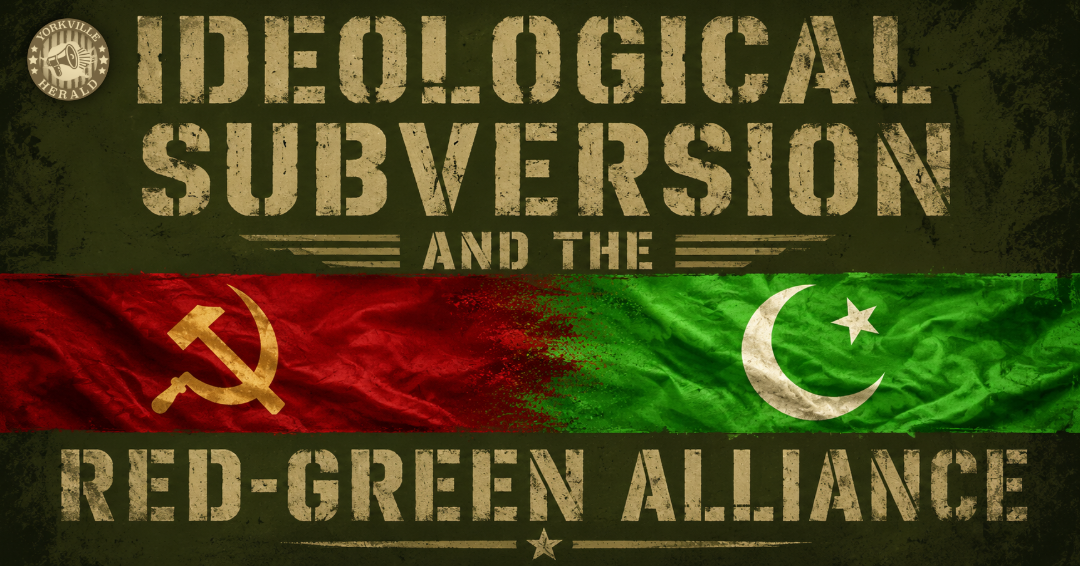
This is where the so-called Red-Green Alliance becomes important. “Red” refers to Marxist, socialist, communist, or radical leftist movements. “Green” refers to Islamist political movements. Islamism is not the same thing as ordinary Islam, and Islamists are not the same thing as ordinary Muslims. Islamism refers broadly to political ideologies that draw from Islamic symbols and traditions in pursuit of sociopolitical objectives. [3] Communism, by contrast, is a political and economic ideology rooted heavily in the writings of Karl Marx and Friedrich Engels, seeking a classless society and public control of the major means of production. [4]
At first, Marxists and Islamists appear to be natural enemies. Marxism is materialist, revolutionary, and often hostile to religion. Islamism is religious, political, and often opposed to the sexual and moral revolution promoted by the Left. But revolutionary movements do not need to agree on the final destination in order to cooperate along the way. They only need a shared enemy. That shared enemy is often Western civilization, Christianity, Israel, capitalism, nationalism, constitutional government, and traditional moral order. The Marxist attacks these things in the language of class struggle, oppression, colonialism, and revolution. The Islamist attacks them in the language of religious grievance, anti-Western resistance, anti-Zionism, and civilizational conflict. The language is different, but the immediate targets often overlap.
Scholars have used the phrase “Red-Green Alliance” to describe this convergence between political Islam and the radical Left. One academic article on the subject argues that radical leftists and Islamists have increasingly used shared frames of anti-capitalism, anti-globalization, anti-colonialism, and anti-imperialism to build common opposition to the United States and its allies. [5] This does not mean the two movements are identical. It means they can become useful to one another when both are working against the same civilizational order.

Bezmenov’s first stage was demoralization. This is the long process of changing the values of a society over a generation. Education, media, churches, entertainment, universities, and public institutions are used to make people lose confidence in truth, patriotism, family, religion, moral authority, and national identity. The goal is not merely to persuade people to believe something new. The goal is to make them unable to recognize reality when it is placed directly in front of them.
Islamists can be useful in this stage because Islamist political demands can be folded into leftist narratives about oppression, anti-racism, anti-colonialism, and minority rights. Criticism of Islamism can be reframed as hatred. Concerns about assimilation can be reframed as xenophobia. Defense of Christian civilization can be reframed as bigotry. In this way, Islamist grievance politics can help demoralize a Christian or Western society by making that society feel morally guilty for defending itself. This does not mean every Muslim is involved in subversion. It means Islamist political movements can exploit the openness, tolerance, and legal protections of Western society while seeking to weaken the very moral and constitutional framework that made those protections possible.
Bezmenov’s second stage was destabilization. Once a society has been demoralized, the next step is to weaken its key structures: foreign policy, law enforcement, economy, national security, and social order. A destabilized nation cannot act with confidence because its people no longer agree on who they are, what is true, what is worth defending, or who the enemy is. The Red-Green Alliance can contribute to destabilization by attacking Western self-defense from two directions at once. Radical leftists accuse the nation of racism, imperialism, capitalism, colonialism, and oppression. Islamists accuse the same nation of hostility to Islam, complicity with Israel, moral corruption, and anti-Muslim persecution. Together, these narratives create pressure on public officials, schools, media, courts, and institutions to treat Western strength as the problem and anti-Western movements as the victims.
This becomes especially powerful in foreign policy. Anti-American, anti-Israel, and anti-Western causes can be presented as liberation movements. Extremist groups can be softened by language like “resistance,” “anti-colonial struggle,” or “freedom fighting.” Meanwhile, the nation’s own police, military, borders, intelligence agencies, and constitutional protections are portrayed as oppressive or illegitimate.
Bezmenov’s third stage was crisis. After years of demoralization and destabilization, a society reaches a breaking point. Crisis can come through war, economic collapse, mass unrest, terrorism, political violence, institutional breakdown, or a manufactured moral panic. The point of crisis is to make the existing order appear incapable of solving the problem. In this stage, radical movements benefit from chaos. Marxists may use crisis to demand revolution, redistribution, emergency powers, or the destruction of existing institutions. Islamists may use crisis to demand special protections, separate accommodations, political recognition, or expanded influence under the banner of grievance and victimhood. Each side can point to the crisis as proof that the old order has failed.
The Iranian Revolution of 1979 is an important historical example of this pattern. The revolution against the shah included Islamists, secular liberals, nationalists, communists, and Islamist-Marxist factions. These groups did not share the same worldview, but they were united by opposition to the shah and Western influence. Once the old order fell, Khomeini’s Islamist faction consolidated power, and many leftists and secular allies were suppressed. The temporary alliance worked long enough to destroy the common enemy, but not long enough to share power afterward. [6]
Bezmenov’s fourth stage was normalization. This is the stage where the new order is presented as the solution to the crisis. What was once radical becomes official. What was once unthinkable becomes normal. The institutions that were captured during the earlier stages now teach the public to accept the new reality. In a Marxist framework, normalization may look like state control, ideological policing, censorship, redistribution, and the remaking of society around revolutionary principles. In an Islamist framework, normalization may look like the growing acceptance of Sharia-based demands, Islamic political identity, separate enclaves, religiously justified legal exceptions, or the treatment of criticism as forbidden hatred.
The danger is not that Marxists and Islamists have identical goals. They do not. The danger is that both can weaken the same civilization at the same time. The Marxist wants to overthrow the Christian and constitutional order in favor of revolutionary secular power. The Islamist wants to weaken that same order in favor of Islamic political and civilizational power. Each side believes it can use the other.
That is why the Red-Green Alliance should not be understood as a perfect friendship. It is a temporary tactical partnership. The Marxist uses Islamist grievance to attack Western civilization, Christianity, Israel, nationalism, and constitutional order. The Islamist uses leftist institutions, activist networks, media narratives, civil-rights language, and legal pressure to gain legitimacy and protection inside the West.
Bezmenov warned that subversion works slowly. It does not begin with tanks in the streets. It begins with ideas in classrooms, slogans in media, lawsuits in courts, propaganda in entertainment, weakness in churches, guilt in the public conscience, and fear among leaders who no longer know how to defend their own civilization.
The final lesson is simple: a nation must be able to distinguish between protecting innocent people and empowering hostile ideologies. Ordinary Muslims have the right to live peacefully, worship freely, and be treated justly under American law. But Islamist political movements are not entitled to use religious liberty, civil-rights language, or minority status as a shield for subversion. Likewise, free speech and compassion should never become tools by which a nation is trained to surrender its own moral, constitutional, and spiritual inheritance.

Molly Krempski
Endnotes
[1] [2] Bezmenov, Yuri. “Interview with Yuri Bezmenov.” Interview by G. Edward Griffin, 1984, bezmenov.neocities.org. Accessed 24 June 2026.
[3] “Islamism.” Encyclopaedia Britannica, Encyclopaedia Britannica, Inc., 9 June 2026, www.britannica.com/topic/Islamism. Accessed 24 June 2026.
[4] “Communism.” Encyclopaedia Britannica, Encyclopaedia Britannica, Inc., 6 June 2026, www.britannica.com/topic/communism. Accessed 24 June 2026.
[5] Karagiannis, Emmanuel, and Clark McCauley. “The Emerging Red-Green Alliance: Where Political Islam Meets the Radical Left.” Terrorism and Political Violence, vol. 25, no. 2, 2013, pp. 167–182. Taylor & Francis Online, doi:10.1080/09546553.2012.755815.
[6] “Ideology and Iran’s Revolution: How 1979 Changed the World.” Tony Blair Institute for Global Change, 11 Feb. 2019, institute.global/insights/geopolitics-and-security/ideology-and-irans- revolution-how-1979-changed-world. Accessed 24 June 2026.