An Open Letter to Illinois Governing Boards
The Folly in Seeking God’s Blessing While Promoting the Occult
Opinion Piece By | Molly Krempski
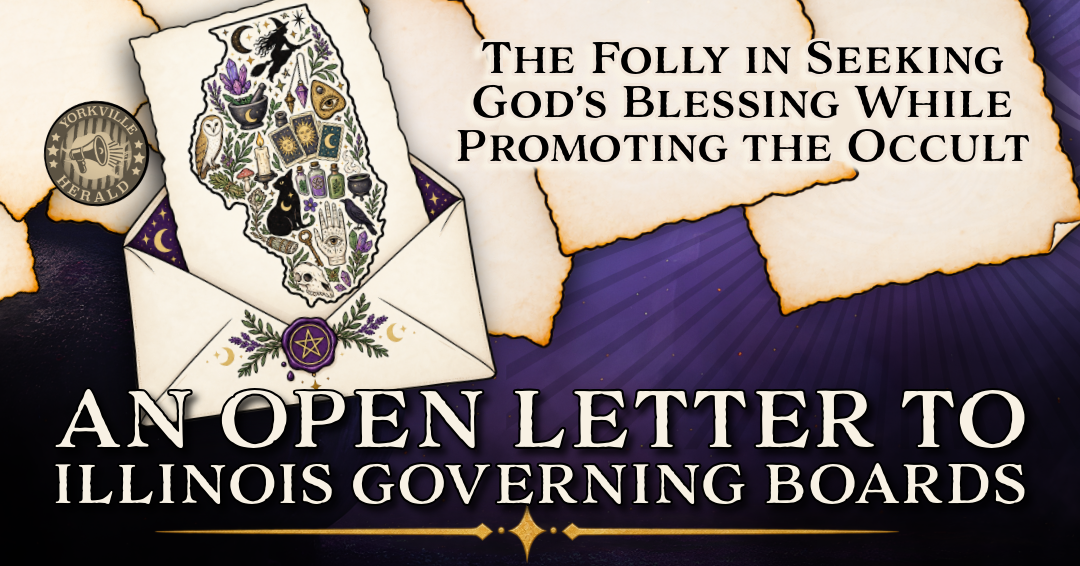
Across Illinois, taxpayer-supported institutions are incorporating tarot readings, divination, astrology, psychic practices, witchcraft, and related occult programming into public offerings. This is not hypothetical, and it is not confined to one town. Public bodies are already spending institutional time, space, staff attention, and public resources to place these practices before Illinois residents.
The Oswegoland Park District advertised a “Halloween Happy Hour: Tarot Reading, Craft & Wine” in 2025 and is offering the same type of program again in 2026, inviting participants to have their tarot cards read as part of Park District programming. The Arlington Heights Park District held an adults-only “Oddities Night” at its historical museum in October 2025 that expressly included a tarot card reader. [1,2]
The Wilmette Park District went beyond a single reading and offered a ten-week adult “Tarot Study Group” in 2025. Its own program guide told participants they would “explore and study TAROT CARDS,” and the Park District supplied decks for the class. The Lincolnwood Public Library likewise offered one-on-one tarot readings to adult library cardholders, inviting patrons to discover what the summer solstice had “in store” for them through readings conducted by a librarian identified as a tarot reader. [3,4]
The relationship between the Sandwich Public Library District and Natural Collective deserves even closer attention. Natural Collective identifies itself as a Sandwich-based metaphysical shop selling crystals, oils, incense, oracle cards, divination materials, ritual and altar supplies, and other tools for spiritual practice. Its own website calls the business a “family-run sanctuary for crystals, energy work, and sacred community,” identifies its founders as spiritualists, and describes its work in terms of intuitive healing, energetic guidance, metaphysical tools, and spiritual journeys. [5]
The Sandwich Public Library has brought that organization into public programming. A 2024 Natural Collective class at the Library taught “Crystal and Energy Protection” and “psychic protection,” including claims that crystals can safeguard against negative energies and “psychic attacks.” In October 2026, the Library is hosting Natural Collective for a Samhain program centered on death, ancestors, spirits, divination, the supernatural, covens, witches gathering in secret, the “witches’ sabbath,” and organized covens within modern witchcraft. Those descriptions come directly from the Library itself. [6,7]
This is not a dispute over whether private citizens have religious liberty. They do. A private citizen can practice witchcraft, consult tarot cards, study astrology, observe Samhain, or reject religion altogether without government suppressing lawful religious exercise. The constitutional protection of private belief, however, does not transform every spiritual practice into something government must organize, finance, advertise, teach, or adopt as public programming.
Private liberty and governmental responsibility are separate questions. A private tarot reading is private religious or expressive conduct. A taxpayer-supported institution arranging the tarot reader, advertising the reading, supplying the classroom, purchasing the decks, hiring the presenter, or incorporating the practice into its own recreational or educational programming is affirmative governmental action. Government does not lose the ability to exercise judgment over its own programming merely because the subject matter is religious.
That distinction carries particular force in Illinois because the Illinois Constitution does not begin from a premise of spiritual neutrality. It begins with “We, the People of the State of Illinois,” declaring themselves “grateful to Almighty God” for the civil, political, and religious liberty He permitted them to enjoy and “seeking His blessing upon our endeavors.” Those endeavors include the health, safety, and welfare of the people, orderly government, justice, domestic tranquility, and securing freedom and liberty for ourselves and our posterity. [8]
Those words are part of the Constitution. They are not decorative filler placed above the legally meaningful portions. Illinois public servants are required to swear that they will support the Constitution of the United States and the Constitution of the State of Illinois and faithfully discharge the duties of their offices. Public officials therefore take an oath to support a Constitution whose opening declaration acknowledges Almighty God, credits Him with the liberties of the people, and seeks His blessing upon the work of government. [8,9]
Illinois judicial history confirms that governmental acknowledgment of God is not inherently unconstitutional. In Van Zandt v. Thompson, the Seventh Circuit reviewed an Illinois House resolution establishing a prayer and meditation room inside the State Capitol. The resolution itself expressly invoked the Illinois Constitution’s Preamble and its acknowledgment of Almighty God. A federal district court struck the resolution down under the Establishment Clause, but the Seventh Circuit reversed and upheld it. [10]
Van Zandt did not turn the Preamble into an independent command requiring government-sponsored prayer, and it did not eliminate constitutional protections for other religions. It did establish that official Illinois governmental action did not become unconstitutional merely because that action expressly acknowledged God and drew upon the religious language of the State Constitution. [10]
The federal constitutional framework has changed even more dramatically since then. For decades following Lemon v. Kurtzman, Establishment Clause analysis included a secular-purpose requirement and encouraged generations of public officials to treat governmental distance from religion as the safest constitutional course. In Kennedy v. Bremerton School District, the United States Supreme Court expressly declared that it had abandoned Lemon and its endorsement-test offshoot and directed Establishment Clause analysis instead toward “historical practices and understandings.” [11,12]
That is a significant change. The old secular-purpose test no longer governs Establishment Clause questions. Government still cannot establish a church, coerce religious observance, or unlawfully discriminate against private religious exercise, but public officials are no longer operating under a constitutional test that begins by demanding a secular governmental purpose. Current doctrine directs them back toward history and tradition, and Illinois’ own constitutional history begins with an explicit acknowledgment of Almighty God. [8,12]
That history cannot be honestly separated from the question now confronting taxpayer-supported institutions. Biblically, divination is forbidden. Witchcraft, fortune-telling, attempts to obtain hidden spiritual knowledge, and related occult practices are not spiritually neutral entertainment. They are satanic practices because they direct people toward spiritual sources and powers that Scripture places in opposition to God.
Changing the packaging does not change the substance. Putting tarot cards beside wine, crafts, historical programming, or library education does not strip divination of its spiritual character. Calling witchcraft “metaphysical,” psychic practices “energy work,” or occult rituals “seasonal programming” does not make them spiritually harmless.
Government therefore faces a real choice when it affirmatively incorporates these practices into public programming. A Constitution that expressly seeks the blessing of Almighty God cannot be treated as though it simultaneously requires public officials to shut off all spiritual judgment when deciding what their institutions will promote. Religious liberty protects the private citizen. It does not require the government to become a promotional vehicle for practices that directly oppose the God whose blessing the people of Illinois expressly sought. [8]
The distinction must still be applied constitutionally. A private religious group using a generally available public meeting room under neutral rules presents a different legal question from a library or park district creating, advertising, funding, staffing, or selecting its own occult program. Government cannot engage in unlawful viewpoint discrimination in a genuinely open public forum, but neither is every government-sponsored program an open forum in which officials have no authority over what the institution itself chooses to offer.
That is where Illinois governing boards must stop hiding behind the language of neutrality. Public bodies make judgment calls constantly. They decide which instructors to hire, which programs to fund, which events to advertise, which partnerships to form, which activities belong on public property, and which uses of taxpayer resources advance the institution’s mission. Spiritual practices do not become exempt from judgment merely because someone can label them religious.
A public library does not violate religious liberty by refusing to provide taxpayer-supported tarot readings. A park district does not suppress witchcraft by declining to build recreational programming around divination. A municipality does not persecute private religion by refusing to place its name, property, staff, money, or promotional channels behind occult practice.
The false choice between promoting occult spirituality and violating religious freedom needs to end. Illinois public bodies can protect private religious liberty while refusing to normalize, subsidize, or promote practices that stand in direct opposition to the Almighty God acknowledged in the Constitution their officials swear to support.
Every Illinois city council, village board, library board, park district board, and other taxpayer-supported governing body should review its programming and partnership policies now. Boards should distinguish between constitutionally protected private expression and activities that the government itself selects, organizes, advertises, funds, sponsors, or incorporates into its own institutional programming.
The Lemon era is over. The Supreme Court has returned Establishment Clause analysis to history and tradition, Illinois’ constitutional history expressly acknowledges Almighty God, and Van Zandt demonstrates that governmental acknowledgment of that reality is not itself unconstitutional. Public officials have no reason to pretend that God must be treated as irrelevant while occult practices are welcomed into taxpayer-supported programming. [8,10,12]
The people of Illinois sought Almighty God’s blessing upon the endeavors of their government. Public officials swear to support the Constitution containing that declaration. Those words demand more than ceremonial respect when boards decide what their institutions will teach, promote, sponsor, partner with, and place the people’s resources behind. [8,9]
Protect private religious liberty completely. Exercise governmental discernment just as seriously. The constitutional right of a private citizen to practice the occult does not create a governmental obligation to promote it, and taxpayer-supported institutions should stop pretending that it does.
Molly Krempski
Sources
[1] Oswegoland Park District, “September & October Event Highlights” (2025 and 2026).
https://www.oswegolandparkdistrict.org/2025/08/26/september-october-event-highlights-2/
https://www.oswegolandparkdistrict.org/2026/08/20/september-october-event-highlights-3/
[2] Arlington Heights Park District, “Oddities Night.” https://www.ahpd.org/event/oddities-night/
[3] Wilmette Park District, Spring/Summer Program Guide 2025, p. 54, “Tarot Study Group.”
https://fliphtml5.com/gqmek/blxu/SpringSummer_Program_Guide_2025/54/
[4] Lincolnwood Public Library, “Tarot Card Readings (C),” June 25, 2025.
https://www.lincolnwoodlibrary.org/event/tarot-card-readings-c-26102
[5] Natural Collective LLC, “About Us,” “Our Store in Sandwich,” collections, and product descriptions.
https://www.naturalcollectivellc.com/pages/about-us
https://www.naturalcollectivellc.com/pages/our-store-in-sandwich
https://www.naturalcollectivellc.com/collections/divination-media
https://www.naturalcollectivellc.com/collections/herbs/products/nettle-leaf-c-s-organic
https://www.naturalcollectivellc.com/collections/herbs/products/lavender-1-2oz
[6] Sandwich Public Library District, “Natural Collective: Crystal and Energy Protection,” July 27, 2024.
https://www.sandwichpld.org/events/calendar/adult-programs/natural-collective-event-4
[7] Sandwich Public Library District, Adult Programs, “Natural Collective: Samhain,” Oct. 10, 2026.
https://www.sandwichpld.org/events/calendar/adult-programs
[8] Illinois Constitution, Preamble. https://www.ilga.gov/documents/commission/lrb/conp.htm
[9] Illinois Municipal Code, municipal officer oath requirement; Illinois Constitution, Article XIII, Section 3.
https://www.ilga.gov/legislation/ILCS/details?ActID=802&Chapter=MUNICIPALITIES&MajorTopic=G
OVERNMENT&Print=True https://www.ilga.gov/documents/commission/lrb/conent.htm
[10] Van Zandt v. Thompson, 839 F.2d 1215 (7th Cir. 1988). https://law.justia.com/cases/federal/appellate-
[11] Lemon v. Kurtzman, 403 U.S. 602 (1971). https://www.law.cornell.edu/supremecourt/text/403/602
[12] Kennedy v. Bremerton School District, 597 U.S. 507 (2022), official U.S. Supreme Court opinion.
https://www.supremecourt.gov/opinions/21pdf/21-418diff_k4l8.pdf