Grassroots Opposition to Sheridan Islamic Enclave Rejects Patriot Front Outreach
Local opposition says concerns over Sharia, zoning, and religious liberty must not be hijacked by racial extremism.
Sheridan, IL | Yorkville Herald
The proposed redevelopment of the former Fox River Resort near Sheridan has become far more than a local land-use dispute. For many residents, the project now raises larger questions about religious liberty, constitutional limits, private community development, local zoning authority, Sharia, outside extremism, and the spiritual direction of the community.
The former resort property is significant by any ordinary measure. It spans roughly 165 acres and includes more than 300 residential-style units, recreational amenities, pools, sports courts, water features, and other resort infrastructure. In ordinary circumstances, redevelopment of such a property would attract attention simply because of its size. But this proposal has drawn unusual scrutiny because the developer’s own promotional materials present the project not merely as a resort, but as a faith-centered Islamic community. [1]
In the promotional video, the property is described as a resort being converted into a community where Muslim families can purchase homes, live permanently, worship, raise children, and build a shared way of life. The presentation references a mosque, school arrangements, halal food, senior housing near the mosque, business opportunities, family life, religious values, and a gated environment designed around Islamic community needs. [2]
Video: RECOVERED!! [3]
Critics question whether a large, gated, faith-centered development could function as a separate religious enclave shaped not only by Islamic worship and culture, but by Sharia, the Islamic religious and legal framework that governs many aspects of Muslim life, including family, finance, morality, business practices, and community order.
Those concerns were also raised by LaSalle County Board member James Reid, a Marine Corps veteran, during a recent county board meeting.
“I have had the experience of seeing how Sharia law works,” Reid said in opposition to the development. “I have seen people stoned to death. I have seen women beaten in the street just for being women. And I will not allow this in this county. I don’t care. This will not happen in LaSalle County. That’s all I gotta say.” [4]
That concern does not mean every Muslim interprets or applies Sharia in the same way. Nor does it mean local government may punish people for private religious belief. The question is narrower and more practical: would any part of this development operate according to religious rules, expectations, dispute-resolution practices, financial structures, or social pressures that exist outside ordinary American civic life and local public accountability?
For many residents, that is the core issue. A mosque alone is constitutionally protected. Muslim families living in Sheridan are constitutionally protected. But a large, gated community promoted around Islamic values, Islamic schooling, halal commerce, senior housing near the mosque, and a shared religious lifestyle raises fair questions about whether Sharia would become a private organizing principle within the development, and whether local officials have fully considered what that means for zoning, oversight, equal treatment, and long-term community impact.
County officials have stressed that no redevelopment plan has been approved and that any change in use would require full zoning review, public hearings, and county board approval. That assurance is important, but it has not ended public concern, because residents continue to question whether the project could proceed under existing resort approvals, a timeshare model, or another structure that would reduce public oversight.
Molly Krempski raised similar concerns when she addressed local officials on June 8, 2026.
She acknowledged at the outset that the legal questions are difficult. If the proposal involved a Christian resort complex, she said, many of the same residents would likely have no objection. She also said that even if they did object, the Constitution and the courts would not permit them to stop it simply because it was Christian, nor should they be able to.
That acknowledgment is central to Krempski’s argument. Her point is that local officials cannot oppose an Islamic development merely because it is Islamic, just as they could not oppose a Christian development merely because it is Christian. Under the current constitutional framework, religious liberty protections apply broadly, and local government is limited in how it may respond.
But Krempski argued that this creates a serious problem when a large religiously centered development is organized around a faith system that conflicts with America’s Christian foundations and constitutional culture. In her view, the Founders understood religious liberty primarily as the protection of denominational freedom under the umbrella of Christianity, not as a mandate requiring American communities to treat Christianity and Islam as equally compatible with the nation’s founding order.
Krempski believes it will be difficult for the Court to return to the Founders’ original understanding of religious liberty, because America is now home to people of many religions and cultures. As a result, she believes the legal system is unlikely to give local communities much room to object to an Islamic development on religious or civilizational grounds alone.
Krempski identified federal action as another possible path, including action involving organizations critics associate with Islamist political influence, such as the Muslim Brotherhood or CAIR. But she also acknowledged that even if such action ever came, it would not likely happen quickly enough to affect the Sheridan proposal.
In her speech, Krempski argued that the ultimate answer is not merely legal or political, but submission to Jesus Christ. She pointed to the rededication of America as “One Nation Under God” in Washington, D.C., on May 17, 2026, and said Sheridan and LaSalle County now have an opportunity to let that same spirit take root locally.
Her message was direct: if the people of Sheridan and their representatives submit to the Lord and stand against Allah, then Allah will flee. Quoting the biblical principle that “Blessed is the nation whose God is the Lord,” she argued that the salvation of the nation, and of the town, will ultimately come only through submission to Jesus Christ.
Krempski and others within The United States Patriots Society argue that this is not racial, ethnic, or personal, but theological. In their view, the conflict is not between Americans of different skin colors or national origins, but between competing spiritual authorities.
That distinction matters because the Sheridan controversy has now attracted attention from outside extremist politics.
According to Krempski, she spoke with a Chicago-area Patriot Front contact at the Mission Township meeting on June 10, 2026. She said the man told her the group wanted to demonstrate in Ottawa on Friday, June 19, where they believed they would receive “maximum exposure.” She said he also claimed he could provide approximately 20 men for a demonstration.
A flyer photographed at the Mission Township meeting bore Patriot Front branding and promoted the slogan “Strong Families, Strong Nations.” While the language sounded pro-family on the surface, the flyer also included explicitly racial language, including a reference to defending “the descendants of the European race.”
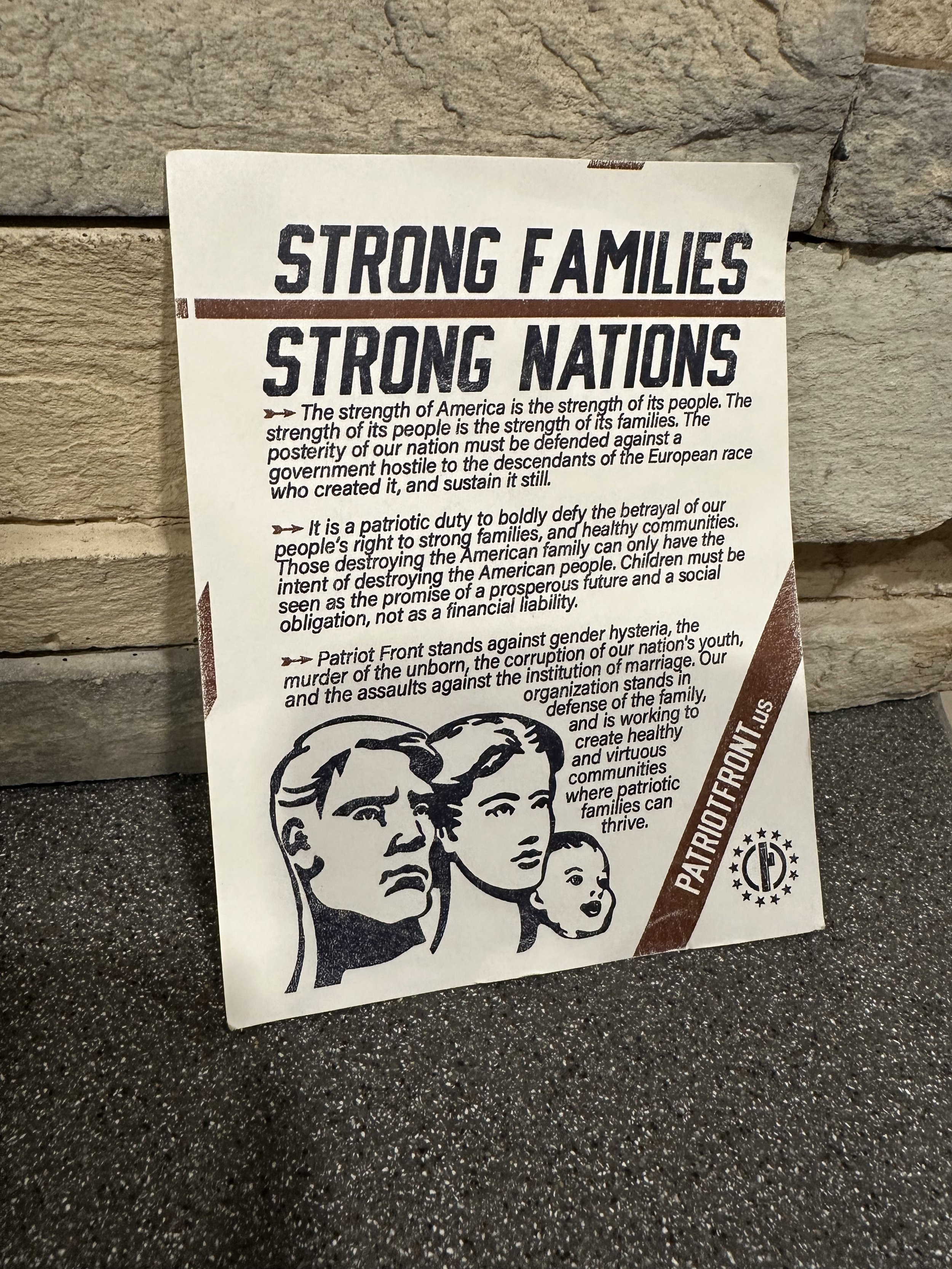
For Krempski and others involved in grassroots opposition to the proposed development, that was the line.
Krempski said she does not want Patriot Front involved in the Sheridan issue and views the group’s outreach as an attempt to derail legitimate conservative opposition. In her view, Patriot Front and similar groups are inserted into, or drawn into, controversies in ways that create chaos inside the conservative movement. The result, she believes, is that legitimate grassroots resistance to leftist or globalist agendas can be discredited, smeared as white supremacy, and disbanded before it gains strength.
Krempski views this as a Marxist-style tactic: keeping people divided, surrounded by chaos, and too afraid to organize against causes that she believes seek to substantially alter American culture and draw it away from its biblical foundations. She believes that is the practical role Patriot Front serves, whether all of its members realize it or not.
She said she did not immediately recognize the organization’s full history during the conversation. Afterward, she looked into Patriot Front and realized it was the group known for appearing in navy blue polos, khaki pants, and white face masks. She said she had previously viewed such groups with suspicion, believing they often function like controlled opposition by attaching themselves to legitimate grassroots movements, importing extremist rhetoric, and inflaming public situations in ways that make ordinary citizens appear radical or dangerous.
Whether one views Patriot Front as an extremist organization, a provocation, or a form of political sabotage, the practical effect is the same: its presence threatens to derail legitimate local opposition to the proposed Islamic enclave.
Patriot Front did not arise out of ordinary grassroots conservatism. It formed after the 2017 “Unite the Right” rally in Charlottesville, Virginia, emerging from Vanguard America, a white nationalist organization associated with that event. Since then, Patriot Front has attempted to make white nationalist politics appear more acceptable by wrapping them in American symbols, military-style discipline, family language, and patriotic slogans.
That is the pattern. The group does not usually enter public debate by announcing itself in the blunt language of racial extremism. It enters by attaching itself to issues ordinary conservatives care about, family, opposition to abortion, immigration, public morality, national identity, and local control, and then bends those concerns toward race.
That same pattern has appeared in pro-life settings. Patriot Front members appeared at a March for Life event in Chicago, where pro-life demonstrators reportedly confronted and heckled them for trying to hijack the movement. Their presence did not strengthen the pro-life cause. It allowed opponents to smear sincere pro-life citizens by associating them with white supremacy.
The danger is not hypothetical. In June 2022, police in Coeur d’Alene, Idaho, arrested 31 Patriot Front members after they were found packed inside a U-Haul truck near a Pride event. Authorities said the men had shields and riot gear and were arrested on suspicion of conspiracy to riot. The point for Sheridan and Ottawa is not simply the final outcome of any one court case. The point is that Patriot Front’s public activity is not normal civic engagement. It is theatrical, masked, confrontational, and designed to create chaos.
The group’s history also includes documented violence. In Boston, a federal judge ordered Patriot Front and its leader to pay more than $2.7 million after finding them liable in a civil-rights case involving a Black musician attacked during a 2022 Patriot Front flash march.
Recent federal allegations involving the Southern Poverty Law Center have also intensified concerns among critics who believe extremist movements are sometimes funded, managed, or amplified in ways that benefit institutions claiming to oppose them. Federal prosecutors have accused the SPLC of fraud connected to payments made through a paid-informant program involving extremists. The SPLC has denied wrongdoing and has argued that its informant work helped monitor violent groups and protect public safety. For critics, however, the indictment reinforces a broader concern: that racial extremism can be politically exploited in ways that serve institutional power rather than ordinary citizens.
There are legitimate questions residents may ask about the proposed resort development: zoning, occupancy, religious institutions, Sharia-based expectations, public safety, schooling, private governance, commercial activity, security, and long-term community impact. Those questions are serious. They deserve serious answers. They require lawful scrutiny, public meetings, documentation, prayer, and moral clarity.
The presence of Patriot Front messaging near the controversy, combined with the reported discussion of a June 19 demonstration in Ottawa, shows how quickly a serious civic issue can be distorted. The debate over the Fox River Resort proposal involves land use, constitutional doctrine, religious liberty, Sharia, local oversight, and the spiritual future of the community. It should not be reduced to race.
The United States Patriots Society presents itself as operating from a very different foundation. Rather than grounding its concerns in race or ethnicity, the organization points to America’s founding principles, constitutional liberty, biblical truth, repentance, prayer, and guidance from the Holy Spirit.
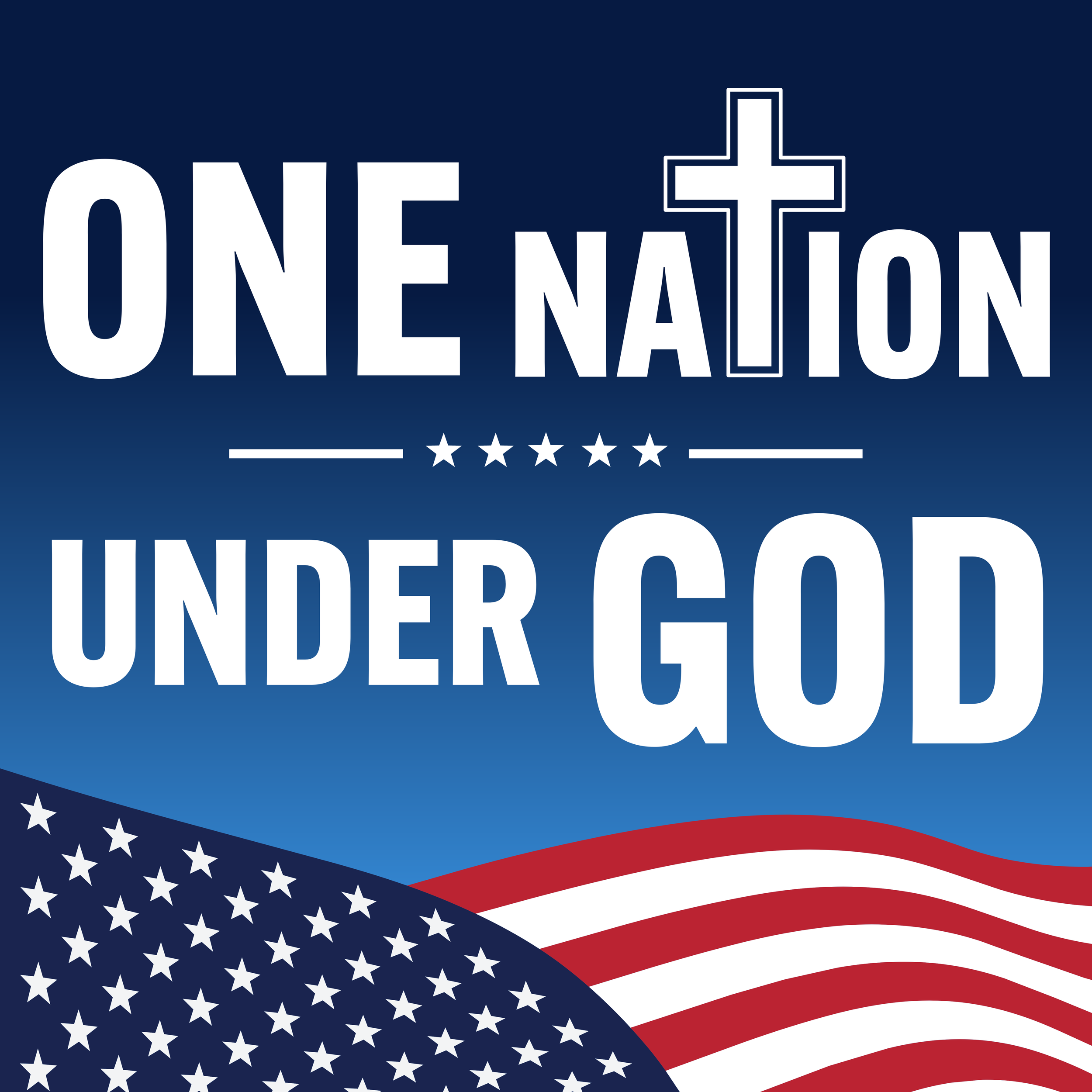
Patriot Front and similar movements attempt to redirect public concern toward blood, soil, race, and grievance. The United States Patriots Society seeks to redirect public concern toward God, constitutional order, civic responsibility, lawful action, and the Christian principles that shaped the American republic.
One approach corrupts the conversation. The other seeks to preserve it.
For those concerned about the proposed Islamic community, the question is not only what local government will do. It is whether citizens will respond with fear or faith, racial grievance or biblical conviction, political theater or lawful courage.
Sheridan now finds itself at the center of a much larger debate over what religious liberty means, what local communities may lawfully protect, whether Sharia-based community structures can coexist with ordinary American civic norms, and whether America’s founding principles will be properly applied to guide public life in a time of deep spiritual and cultural conflict
Endnotes
[1] “Fox River Resort At Sheridan.” Matthews Real Estate Investment Services, Matthews, https://www.matthews.com/properties/hospitality-fox-river-resort-at-sheridan-sheridan-il. Accessed 19 June 2026.
[2] Sukhera, Jamil. “$400 Million 5-Star Community Tour.” VEED, 6 May 2026, https://www.veed.io/view/becb796a-97d0-4ad5-8843-1284852672d2?panel=download
[3] Krempski, Molly. “RECOVERED!! Vairt Resort Promo Video Sheridan, Illinois (English Subtitles).” YouTube, uploaded by ACrazyEagle1, 6 May 2026, https://youtu.be/8fX1l2lUyzo
[4] “Full Board 6/8/2026.” YouTube, uploaded by LaSalle County Board, 8 June 2026, https://www.youtube.com/live/SeEW9RaJzcE