Public Education Should Not Price Families Out of Their Homes
Opinion Piece By | Molly Krempski
Yorkville CUSD 115 voters are being asked to consider a $159 million bond referendum to address the district’s growing enrollment and facility needs. The proposal would authorize bonds to build and equip a new middle school and a new elementary school.¹ The larger question surrounding that proposal is not simply whether the district needs more space, but how much financial responsibility local taxpayers can reasonably be expected to carry.
The current overcrowding problem is real, and the present referendum is focused primarily on adding classroom capacity. But that does not make the broader spending question irrelevant. A community can still experience a form of amenity-driven gentrification when its public institutions continually expand the level of services and experiences taxpayers are expected to provide. What may have begun as a sincere effort to give every child access to more opportunities can eventually create a different kind of inequality if the cost of providing those opportunities makes the community unaffordable for families with more modest incomes. A public school system should not become so expensive to sustain that the very families it was meant to serve can no longer afford to remain in the district.
The burden placed on taxpayers deserves serious consideration when evaluating the affordability and long-term fiscal sustainability of the proposed referendum, without making people feel selfish for questioning it. From 2020 to 2024, the median home value in the Yorkville 60560 area rose from about $273,500 to $346,300 - an increase of nearly 27%. During that same period, median household income rose from roughly $102,100 to $110,300 - an increase of only about 8%.² That matters for school funding because when property values rise, the state sees a larger local tax base and assumes the district has a greater ability to raise money locally. Illinois’ Evidence-Based Funding formula specifically uses Equalized Assessed Value, or EAV, in determining a district’s expected local contribution toward the cost of education.³ In simple terms, rising property values can make Yorkville appear more capable of funding its own schools, even when household incomes are not keeping pace.
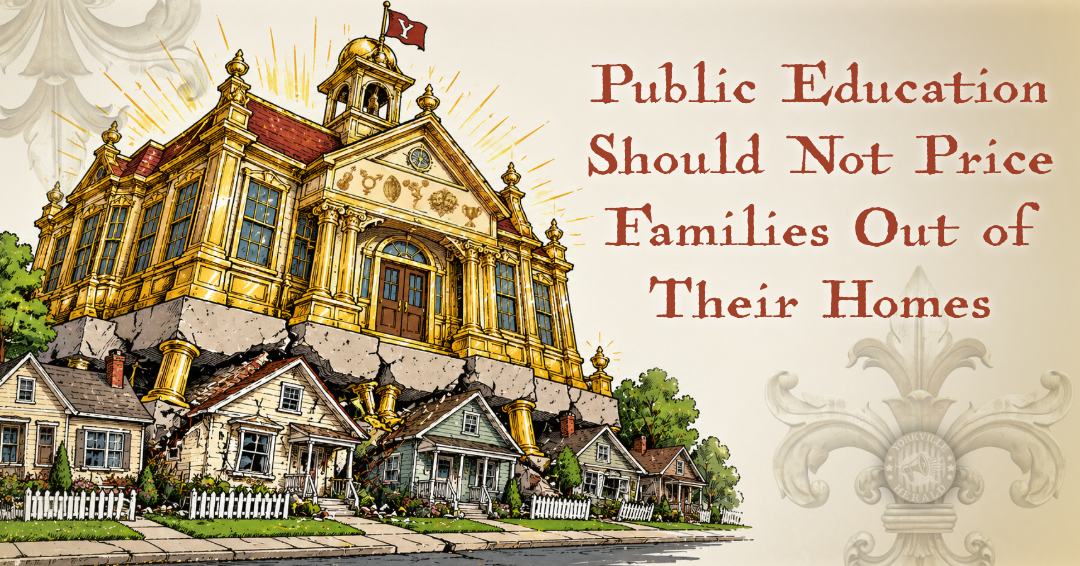
That creates a real disconnect. Families do not pay property taxes with the theoretical value of their homes. They pay them with actual income. A house becoming worth 27% more does not give a family 27% more money to spend. Mortgages, utilities, insurance, groceries, vehicles, childcare and every other household expense still have to be paid. For retirees and families living on fixed or modest incomes, that pressure can be even greater. Rising home values may make a family look wealthier on paper, but they do not necessarily make that family more financially secure.
Y115 is growing, and the district has legitimate capacity concerns. The current referendum would authorize $159 million in bonds, and the district says those bonds can be issued with a “zero tax rate increase.”¹ But keeping the rate flat is not the same thing as saying the bonds have no cost. The debt still has to be repaid with tax revenue, and a growing property-tax base can allow the district to collect more money even while the rate stays the same or declines. That distinction matters when taxpayers hear phrases like “zero tax increase.” But the debate should not stop with the structure of this particular bond proposal.
Athletics, clubs, performing arts and other extracurricular opportunities all have value, but that does not mean every experience must be provided at increasingly sophisticated levels through the public school system and financed through property taxes. Families routinely make choices about which extracurricular activities they can afford for their own children. Public institutions should also be expected to distinguish between what is necessary for education and what is desirable but optional.
When schools take on more extracurricular, social and cultural functions, the cost of the system grows and financial flexibility shrinks. Money devoted year after year to non-core programs and facilities is money that cannot be reserved for future classrooms, teachers, building needs and other essential infrastructure. So while the current referendum is about a legitimate capacity problem, the financial pressure did not begin with this referendum. Earlier spending priorities are relevant because they may have left taxpayers with less room to meet essential needs without taking on additional debt.
Public schools should first and foremost educate children. More resources should be directed toward strong academics and measurable educational outcomes, and less toward ideological, cultural or social programming that extends beyond the core educational mission and into areas many families believe belong primarily in the home.
Schools should not become increasingly elaborate social and athletic institutions while the families paying for them struggle to remain financially secure in their own homes. That’s not right. Schools can provide opportunities, but families can also take responsibility for many extracurricular experiences outside the public-school system. Taxpayers should not be expected to fund every activity that could enrich a child’s life simply because it would be convenient to provide it through the school district.
A child benefits from a good school, but that same child also benefits from parents who can afford their mortgage, groceries, insurance, utilities and the ordinary costs of raising a family. Those things should not be treated as competing values.
A taxpayer can recognize that Y115 has a capacity problem while still questioning whether $159 million in additional debt is the best solution. A taxpayer can appreciate teachers while expecting greater spending discipline, and can support athletics and extracurricular activities while believing families, private organizations and community groups should carry more responsibility for providing them. Questioning additional debt is not opposition to education. It is a legitimate discussion about priorities and affordability.
The goal should not be to build the best school system money can buy. It should be to build the best school system the community can responsibly sustain. A healthy public school system should provide strong academics, safe buildings, qualified teachers and the resources necessary for children to learn while allowing the families supporting it to remain financially secure. Those two goals should never be in conflict.

Molly Krempski
Sources
¹ Yorkville Community Unit School District 115 - Y115 Facilities and 2026 Referendum Information.
https://www.y115.org/about-y115/y115-facilities
² U.S. Census Bureau American Community Survey data for ZIP Code 60560, historical data compiled by ZIP-Codes.com.
https://www.zip-codes.com/zip-code/60560/zip-code-60560.asp
³ Illinois State Board of Education - Evidence-Based Funding, Public Business Rules.
https://www.isbe.net/Documents/Public-Business-Rules-2025-RC-Metrics.pdf