By | Michael Krempski
Election-validity organization Unite4Freedom (U4F) has released a report stating that hundreds of thousands of changes were made to Illinois voter-history records after federal elections had already been certified, raising questions about election-record preservation, administrative procedures, and the ability of citizens to independently verify election results years after an election concludes. The organization says the Illinois findings are part of a broader national effort examining election records and election administration practices in 35 states.
The group's Illinois Vote Tampering Report, released June 11, 2026, analyzes official Illinois voter-participation records from multiple snapshots of the state's voter database and compares records collected after federal election certifications. According to Unite4Freedom, the analysis identified significant differences in voter histories associated with the 2020, 2022, and 2024 federal election cycles.
For the 2024 election alone, the organization reported finding 254,027 changes in two sequential comparisons of database snapshots obtained between January 24, 2025, and May 13, 2026. U4F says those changes included nearly 110,000 voters who were initially recorded as voting but later appeared as not voting, more than 15,000 voters whose status changed from non-voter to voter, and tens of thousands of voter records that appeared or disappeared between database versions. The report also cites 288,447 changes associated with the 2022 election and 472,581 changes connected to the 2020 election.
“This raises a fundamental question,” the report states. “If election results were accurate when certified, why are voter histories associated with those certified elections continuing to change years later?”
U4F Chairman Harry Haury has argued that election certification should represent a final and accurate record of election activity and that election officials should be able to demonstrate that certified records remain preserved and verifiable over time.
The organization stresses that its report focuses on election-record integrity rather than on making claims about specific election outcomes. In an interview accompanying the report, Harry Haury emphasized that its concerns center on transparency and accountability rather than allegations about specific election outcomes.
“We are not alleging that every discrepancy represents misconduct or changed an election outcome. Rather, these discrepancies indicate that official records have changed in ways that warrant explanation.”
According to Unite4Freedom, election records serve as the official evidence used to verify whether elections were conducted lawfully and whether certified results accurately reflect voter participation. Haury went on to say:
“If election records cannot be shown to be complete, consistent, and preserved as required by law, it becomes more difficult for election officials to independently demonstrate that election results are accurate and fully auditable. Regardless of political affiliation, the public should expect election records to support confidence in certified results through objective, verifiable evidence.”
The organization reports that the voter-history data snapshots analyzed were sourced directly from the Illinois State Board of Elections (ILSBE) through a qualified organization. Unite4Freedom states that volunteers follow established chain-of-custody protocols to preserve data integrity from acquisition through analysis. The organization maintains that the datasets were authenticated using the original transmittal records and corresponding hash files, providing verification of the data's authenticity and integrity
U4F further states that its reports are reviewed by a team of volunteer analysts with backgrounds in major corporations, government agencies, and data-analysis fields. According to the organization, several of its analyses have been submitted as evidence in court filings across the country.
While summary reports are publicly available, Unite4Freedom says the detailed query output is not publicly released because it contains protected personal information. The organization states that its findings have been shared with state election officials and federal authorities, including the U.S. Department of Justice.
Unite4Freedom also points to findings contained in its Illinois 2024 Election Validity Scorecard, which the organization says provides additional evidence of voter-registration irregularities beyond the voter-history discrepancies identified in the Vote Tampering Report. According to U4F, the scorecard documents that millions of registrants on the voter rolls do not appear to be legally eligible or qualified to vote, along with more than 1 million votes that were nevertheless counted from those registrations.
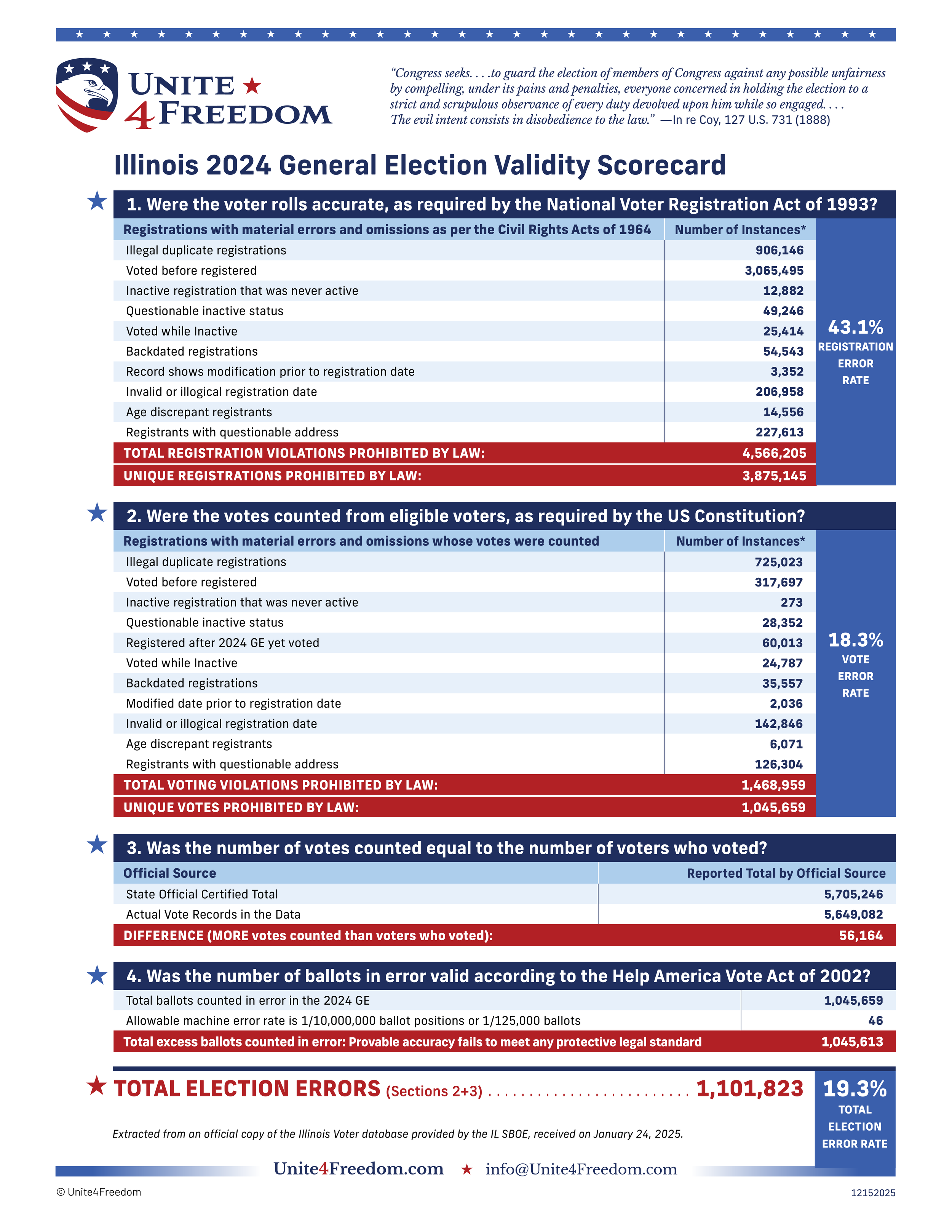
The report raises a series of questions about voter-registration records and election administration, including why 725,023 duplicate registrants were reportedly permitted to vote and how 317,697 voters were recorded as having cast ballots before their voter registrations were established. Unite4Freedom notes that many of the voting errors identified in Section 2 of the scorecard involve registration-date anomalies and related discrepancies.
According to the organization, those findings were among the factors that led it to conducting the Illinois Vote Tampering analysis. U4F says the registration-date issues identified in the Election Validity Scorecard and the voter-history changes documented in the Vote Tampering Report should be viewed as related concerns involving the accuracy, preservation, and auditability of official election records.
According to the organization, it previously provided its Illinois findings and supporting data to the Illinois State Board of Elections. U4F says the Board returned a USB drive containing discrepancy data associated with the 2022 election, citing security concerns and stating that it could not evaluate the contents. The organization further notes that the Board informed it that the agency is not a law-enforcement entity and lacks investigative authority regarding voter-fraud matters.
Unite4Freedom says it also submitted a suspicious activity report in 2024 to Illinois state officials, Homeland Security, the FBI, and the Department of Justice. According to the organization, the governor's office referred the matter back to the Illinois State Board of Elections.
Unite4Freedom says its report does not claim that the record changes affected election outcomes. Rather, it says the analysis raises concerns about adherence to lawfully required controls that safeguard the election system.
“We are not making any assertions on outcomes, intent, or responsibility. We are arguing that the data analyses that we have conducted provide evidence that the laws governing the conduct of federal elections under the Voting Rights Act, National Voter Registration Act, the Help America Vote Act and the U.S. Constitution are not being followed, and that an election cannot be legally certified as accurate if that is the case.”
The organization also points to federal election-record preservation requirements, including 52 U.S.C. § 20701, which generally requires election officials to preserve records relating to federal elections for 22 months following an election.
Unite4Freedom maintains that its concerns extend beyond Illinois. The organization says its broader election-analysis program has examined election records in 35 states and identified similar discrepancies in voter-registration and voter-history data.
“Additionally, our State Election Validity Scorecards show that in the 35 states U4F has studied, there is not one state where the certified election tally (number of ballots counted) matches the number of voters who were recorded as having voted in the election.”
The Illinois report is one of many state-specific investigations released by the organization. Through a series of reports and press releases, Unite4Freedom has published election-validity scorecards, phantom-voter reports, vote-tampering analyses, litigation updates, and other election-related findings involving states across the country. The group says its research has been used in multiple federal lawsuits and that it intends to continue publishing reports and pursuing legal and legislative remedies based on its findings.
The report's release comes amid renewed national attention on election integrity. On July 16, 2026, President Donald Trump delivered a televised address in which he highlighted election security as a major national issue, announced the release of declassified intelligence related to election-system vulnerabilities, and urged Congress to consider additional election-security measures, including voter-identification and proof-of-citizenship requirements.
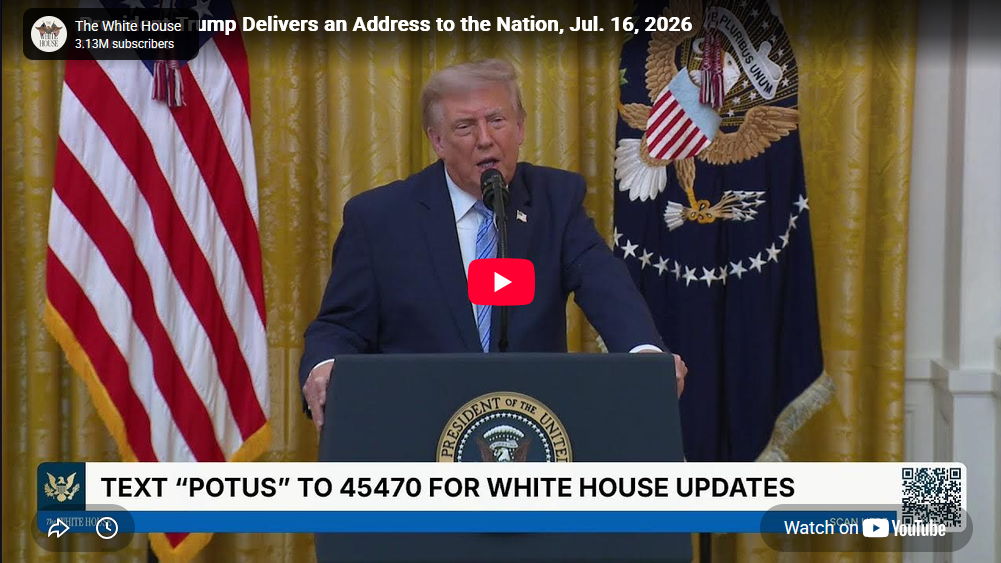
The White House, "Election Integrity," https://www.whitehouse.gov/election-integrity/ (accessed July 20, 2026). Screenshot by Yorkville Herald. [whitehouse.gov]
During the address, Trump argued that Americans deserve confidence that elections are secure, transparent, and protected from both foreign interference and administrative weaknesses. While Unite4Freedom's Illinois report focuses specifically on voter history records, the organization's findings intersect with broader debates about election transparency, auditing, and public confidence in election administration.
Critics of election-fraud claims have frequently argued that changes in voter-registration databases can occur for legitimate administrative reasons, including voter-roll maintenance, record corrections, data synchronization, and system updates. Unite4Freedom acknowledges that possibility but contends that transparency, not speculation, is the central issue.
“Routine administrative corrections certainly occur in every large database, and we acknowledge that possibility. The question is not whether changes can occur—it is whether those changes are documented, lawful, and fully explainable.”
The organization says it is seeking a full public accounting of why the reported changes occurred, who authorized any modifications, what safeguards exist to prevent unauthorized changes, and how election officials can demonstrate that records have been preserved in compliance with state and federal law.
“If the changes are routine and properly documented, then demonstrating that should strengthen public confidence. If they cannot be fully explained, that raises legitimate questions that deserve further review.”
What is clear is that the Illinois report has added another chapter to an increasingly national conversation about election validity, administration, record retention, transparency, and public trust. With Unite4Freedom now reporting similar concerns across 35 states and continuing to publish state-by-state analyses, pressure is likely to grow on election officials to provide detailed explanations, auditable documentation, and greater transparency surrounding election records. As debates over election integrity continue nationwide, the organization's central question remains straightforward: can election records be independently verified years after certification, and, if so, can election officials clearly demonstrate that verification to the public?
Sources
Unite4Freedom. Unite4Freedom Exposes Vote Tampering in Illinois. 11 June 2026, Unite4Freedom, https://unite4freedom.com/wp-content/uploads/2026/06/Unite4Freedom_PressRelease_2026-06-10_IL-VT.pdf. Accessed 15 July 2026. [unite4freedom.com]
llinois Vote Tampering Report. Unite4Freedom, 10 June 2026, https://unite4freedom.com/wp-content/uploads/2026/06/Unite4Freedom_Vote-Tampering_IL_2026-06-10_rev.pdf. Accessed 15 July 2026. [unite4freedom.com]
Haury, Harry. “Unite4Freedom Exposes Vote Tampering in Illinois.” Email interview. Received by Yorkville Herald, 18 July 2026.
“Donald Trump Speech, Primetime Address, White House, July 16, 2026.” Factbase Transcripts, Roll Call, 16 July 2026, https://rollcall.com/factbase/trump/transcript/donald-trump-speech-primetime-address-white-house-july-16-2026/. Accessed 17 July 2026. [rollcall.com]
“Election Integrity.” The White House, https://www.whitehouse.gov/election-integrity/. Accessed 20 July 2026. [whitehouse.gov]