THE FOUNDERS’ DANGEROUS GAMBLE
Religious Liberty, Suicidal Immigration, and the Marxist Remaking of America
Opinion Piece By | Molly Krempski
The First Amendment was not written for a religiously neutral society in the modern sense. It was written by men governing an overwhelmingly Christian people in a nation whose moral assumptions, institutions, and understanding of liberty had been deeply shaped by Christianity. The early national government appointed chaplains, supported publication of the Bible, proclaimed days of prayer, fasting, thanksgiving, and repentance, and openly encouraged Christian morality. [1]
The religious-liberty controversy that produced the First Amendment arose within that Christian civilization. Americans had inherited systems in which governments favored established churches, imposed religious assessments, and disadvantaged dissenting denominations. Baptists, Presbyterians, Congregationalists, Anglicans, Catholics, Quakers, and others fought over establishment, taxation for churches, qualifications for public office, and liberty of conscience.
The immediate problem before the Founders was how to protect conscience and denominational freedom while preventing government from allowing one religious sect to dominate another. They were not designing the First Amendment in response to the modern challenge of governing large populations representing radically different religious, political, moral, and legal traditions.
The First Amendment prohibited Congress from making a law respecting an establishment of religion or prohibiting its free exercise. Its language was deliberately broad. It does not say “free exercise of Christianity.” But that broad protection of religious conscience was adopted within a predominantly Christian civilization whose immediate concern was governmental coercion of conscience and conflict among religious denominations. [2]
Article VI’s prohibition on religious tests arose from the same historical setting. Religious tests in England and the colonies had allowed established churches and governments to reserve political power for believers associated with favored denominations. The Constitution instead declared that no religious test would be required for federal office. [3]
The 1788 North Carolina ratification debates reveal exactly what the Founders assumed would make that freedom workable. Henry Abbot warned that without a religious test, “pagans, deists, and Mahometans” could someday obtain federal office. James Iredell did not deny the possibility. He argued that religious tests were ineffective because a dishonest man could profess whatever belief was necessary to obtain power while a conscientious dissenter might refuse and be excluded. [4]
But Iredell also considered it extremely unlikely that Americans would voluntarily entrust their most important rights to people whose religious principles were materially different from their own. When delegates raised the possibility that Jews, Muslims, pagans, and other non-Christians might immigrate and eventually exercise political power, Governor Samuel Johnston predicted continued Christian numerical predominance and expected assimilation into the existing culture. [5]

That exchange exposes one of the most important assumptions underlying the constitutional system. The Founders could reject government-imposed religious tests because they expected the character, faith, judgment, and culture of the American people themselves to provide a safeguard that government coercion could not. They trusted the Christian electorate to judge the character and beliefs of its representatives for itself.
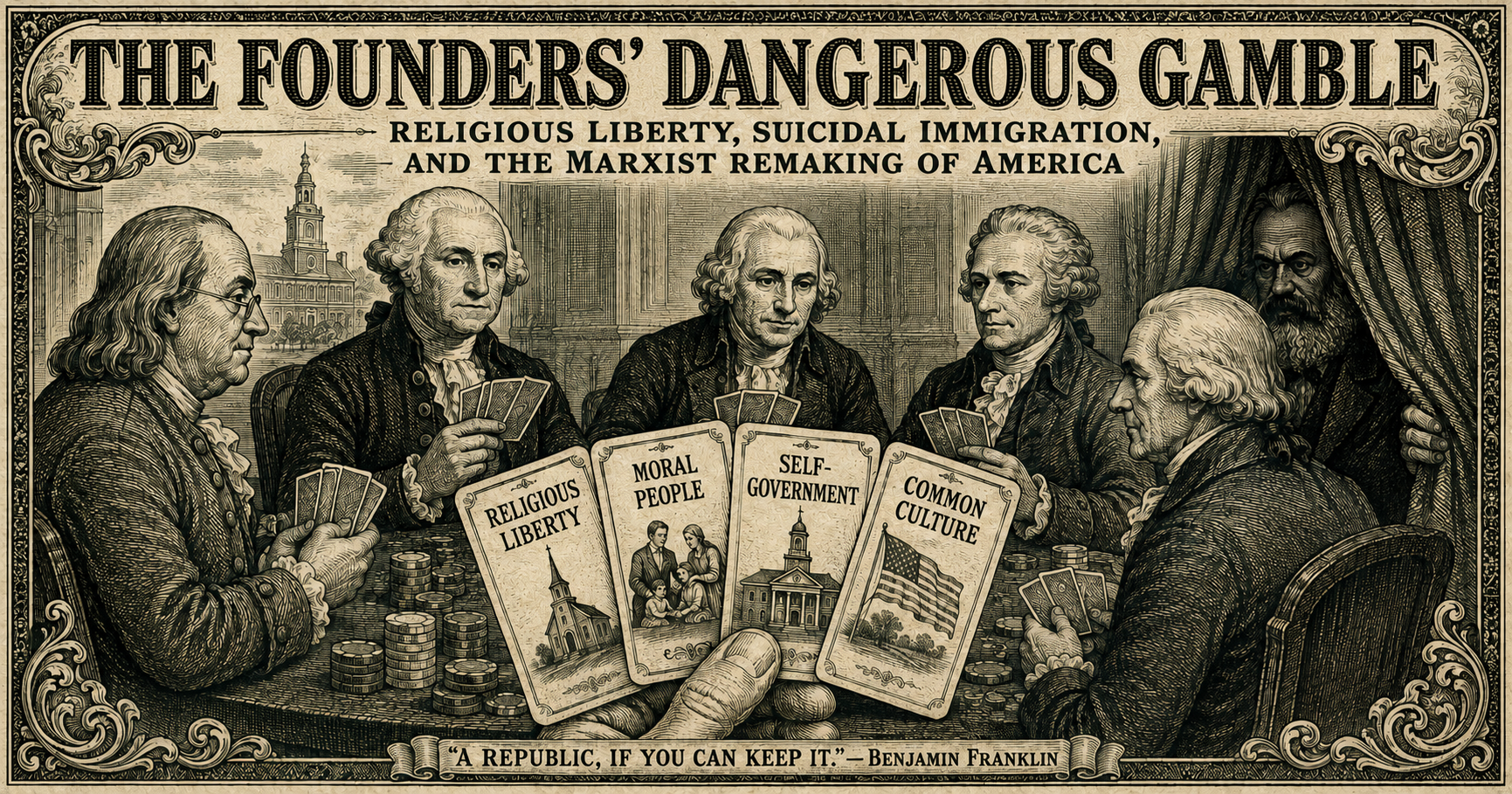
This was the Founders’ dangerous gamble.
They intentionally restrained government because they expected restraint within the people. They created enormous areas of individual liberty because they assumed families, churches, communities, moral traditions, and religious conviction would perform much of the work that an authoritarian state otherwise performs through force.
John Adams expressed the principle with startling clarity in 1798:
“Our Constitution was made only for a moral and religious People. It is wholly inadequate to the government of any other.” [6]
The Constitution was therefore never an autonomous machine capable of governing any imaginable population under any imaginable moral conditions. It depended upon the character of the people operating it.
That understanding makes immigration much more than an economic question. The Founders did not construct their system on the assumption that future governments would adopt immigration policies capable of rapidly transforming the religious, cultural, and political character of the American population while expecting the constitutional structure to function exactly as before. The North Carolina debates reveal the opposite assumption. When confronted with immigration by populations holding very different religious beliefs, defenders of the Constitution relied upon continued Christian predominance and assimilation into the existing civilization. [7]
An immigration policy can therefore become constitutionally suicidal without formally repealing a single word of the Constitution. A system dependent upon shared allegiance, moral restraint, assimilation, respect for the rights of others, and acceptance of a common civil order becomes increasingly vulnerable when government stops caring whether incoming populations share or eventually adopt those commitments.
Every word of the First Amendment and Article VI can remain exactly where they are while the conditions that once made those protections workable disappear. If assimilation weakens, the population changes rapidly, families and churches lose their formative power, and citizens no longer share a common moral and civic tradition, written constitutional protections may no longer be enough to preserve the kind of liberty the Founders intended.
The Founders were saying, in effect: Our republic can remain free because religion forms the conscience, families form the child, communities reinforce moral restraint, citizens share a common civic culture, and the people can therefore be trusted with extraordinary liberty.
The historical record almost reads as though the Marxists were hiding behind a curtain at the Constitutional Convention taking notes, because generations later, Marxist thinkers began identifying those very same institutions - religion, family, education, morality, culture, and national identity - as foundations that could be exploited to transform society. The symmetry is hard to miss. The institutions the Founders relied upon to sustain liberty became many of the same institutions Marxist thinkers recognized as essential to remaking society.
On January 10, 1963, Representative A. S. Herlong Jr. placed a document titled “Current Communist Goals” into the Congressional Record. The 45-point list came from Cleon Skousen’s The Naked Communist. Congress recorded the list but did not adopt it as an official finding. What makes the document so striking is how closely the institutions it identifies correspond to the foundations upon which the Founders had placed their gamble: schools, churches, morality, sexuality, family, parental authority, media, American history, the Founders themselves, the Constitution, and international government. [8]
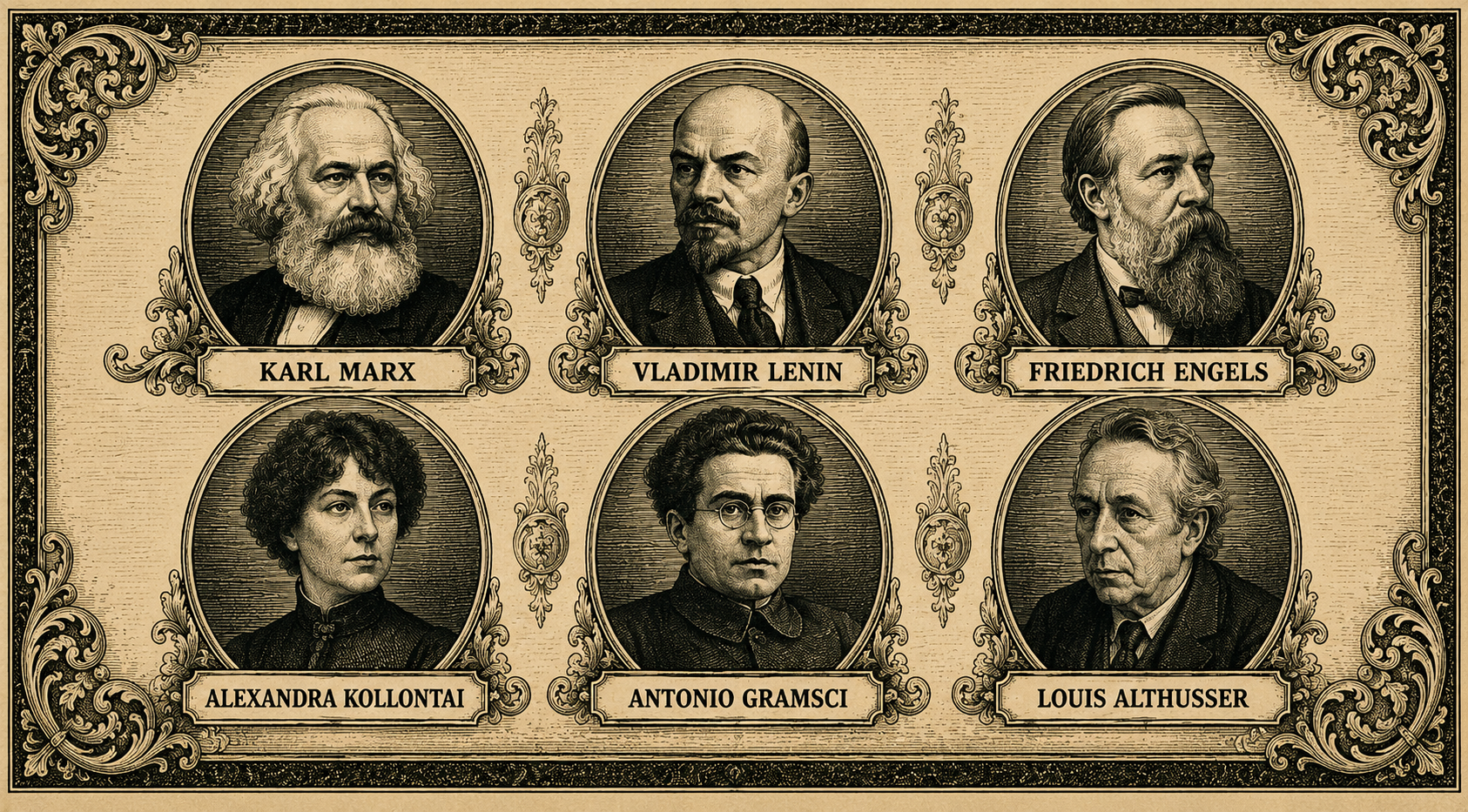
The primary Marxist writings make the pattern even clearer. Marx placed the attack on religion at the beginning of his revolutionary critique, writing that “the criticism of religion is the prerequisite of all criticism.” For Marx, remaking society required challenging the transcendent authority upon which the existing moral order rested. Engels later described the Marxist movement as having “purely and simply finished with God.” Lenin carried the principle directly into political organization, demanding separation of both Church and State and School and Church while insisting that socialism itself could never remain neutral toward religion. Marx and Engels also wrote about transforming the traditional family and shifting important educational functions away from the home, while Alexandra Kollontai envisioned communist society gradually assuming responsibilities once belonging to parents as family functions passed into collective institutions. The effort to remove God from the formation of society was embedded in Marxism’s philosophical foundation. [9]
Later Marxist thinkers focused even more directly on the institutions that shape public belief. Antonio Gramsci emphasized gaining cultural and intellectual influence throughout society. Louis Althusser identified schools, churches, families, political organizations, communications, and cultural institutions as places through which societies teach and reproduce their beliefs. Marxist thinkers also challenged inherited assumptions about marriage, sexuality, family authority, and traditional morality. [10]
Stripped of academic language, the strategy is easy to understand. Schools shape children. Families transmit morality. Churches teach ultimate authority. Media and entertainment determine what society accepts as normal. Universities train future leaders. Change those institutions, and over time you change the people themselves.
That is what makes the 1963 list worth examining. Many of the institutions Skousen identified as targets were the very institutions Marxist theorists themselves described as central to transforming society.
Immigration adds another dimension. “Open the borders” was not one of Skousen’s 45 listed goals, so its connection must be established separately. Classical Marxism was openly internationalist, and Marx and Engels anticipated the weakening of national distinctions. Modern American communist and socialist organizations have gone much further by stating their immigration goals directly. Communist Party USA has advocated legalization and citizenship for undocumented immigrants and broader immigration opportunities. Democratic Socialists of America issued a 2021 statement titled Abolish CBP and Let Them In, calling for deportation flights to end, the border to be demilitarized, migrants to be admitted, and major immigration-enforcement institutions to be dismantled. [11]
Placed beside the Founding record, the contrast is extraordinary. The Founders protected religious liberty because they trusted a moral and religious people. They rejected government religious tests because they trusted the electorate to exercise religious and moral judgment for itself. They limited governmental power because they expected families, churches, communities, and individual conscience to restrain people internally. When confronted with the possibility of immigration from radically different religious traditions, they assumed continued Christian predominance and assimilation.
Marxist thinkers looked at many of those same institutions and recognized that they were precisely how the existing civilization reproduced itself from one generation to the next. Religion, family, education, morality, culture, national identity, and the beliefs passed from parents to children therefore became natural places to transform society.
The deeper threat to a constitutional republic does not require an army marching into Washington to burn the Constitution. A nation can leave its Constitution safely under glass while gradually destroying the kind of people capable of living under it.
Remove religion from the formation of children. Transfer increasing moral authority from parents to institutions. Teach generations to distrust their own history and civilization. Treat inherited moral restraints as oppression. Weaken churches and families. Replace a common national identity with competing identities. Permit mass unlawful immigration while treating assimilation and constitutional allegiance as secondary concerns. Discredit the Founders and teach citizens to regard their Constitution as an obstacle to progress.
The Constitution can survive every one of those developments on paper while the civilization capable of sustaining it disappears underneath it.
The Founders understood this vulnerability because they knew that freedom requires self-government in the deepest sense of the term. A government powerful enough to control every destructive belief, prevent every abuse of liberty, and manufacture morality in every citizen would no longer be the limited government they created. The final defense of the republic therefore had to reside within the people themselves: their faith, families, moral discipline, knowledge of their history, allegiance to their constitutional order, and willingness to transmit those things to their children.
That makes Benjamin Franklin’s famous words at the conclusion of the Constitutional Convention sound increasingly less like a clever remark and more like a prophetic warning across the centuries. When Elizabeth Willing Powel asked what form of government the Convention had produced, Franklin reportedly answered:
“A republic, if you can keep it.” [12]
The Founders could divide governmental power. They could protect conscience, prohibit religious tests, secure speech, restrain government, and write down the rules by which a free people might govern themselves. What they could never guarantee was that future generations would remain the kind of people capable of keeping the republic they had been given.

Molly Krempski
Endnotes
[1] Library of Congress. “Religion and the Congress of the Confederation.” Religion and the Founding of the American Republic, Library of Congress, https://www.loc.gov/exhibits/religion/rel04.html. Accessed 11 Aug. 2026.
[2] Library of Congress. “Religion and the Federal Government, Part 1.” Religion and the Founding of the American Republic, Library of Congress, https://www.loc.gov/exhibits/religion/rel06.html. Accessed 11 Aug. 2026.
[3] Library of Congress. “Religion and the Federal Government, Part 1.” Religion and the Founding of the American Republic, Library of Congress, https://www.loc.gov/exhibits/religion/rel06.html. See also “Debate in North Carolina Ratifying Convention.” The Founders’ Constitution, University of Chicago Press, https://press-pubs.uchicago.edu/founders/documents/amendI_religions52.html. Accessed 11 Aug. 2026.
[4] Elliot, Jonathan, editor. The Debates in the Several State Conventions on the Adoption of the Federal Constitution. 2nd ed., vol. 4, pp. 191–200, 208–09. Reproduced in The Founders’ Constitution, University of Chicago Press, “Debate in North Carolina Ratifying Convention,” 30 July 1788, https://press-pubs.uchicago.edu/founders/documents/amendI_religions52.html. Accessed 11 Aug. 2026.
[5] Elliot, Jonathan, editor. The Debates in the Several State Conventions on the Adoption of the Federal Constitution. 2nd ed., vol. 4. Reproduced in The Founders’ Constitution, University of Chicago Press, “Debate in North Carolina Ratifying Convention,” 30 July 1788, https://press-pubs.uchicago.edu/founders/documents/amendI_religions52.html. Accessed 11 Aug. 2026.
[6] Adams, John. “To the Officers of the First Brigade of the Third Division of the Militia of Massachusetts.” 11 Oct. 1798. The Works of John Adams, edited by Charles Francis Adams, vol. 9, Little, Brown, 1854, p. 229. Online Library of Liberty, https://oll.libertyfund.org/quotes/john-adams-religion-constitution. Accessed 11 Aug. 2026.
[7] Elliot, Jonathan, editor. The Debates in the Several State Conventions on the Adoption of the Federal Constitution. 2nd ed., vol. 4. Reproduced in The Founders’ Constitution, University of Chicago Press, “Debate in North Carolina Ratifying Convention,” 30 July 1788, https://press-pubs.uchicago.edu/founders/documents/amendI_religions52.html. Accessed 11 Aug. 2026.
[8] Herlong, A. S., Jr. “Current Communist Goals.” Congressional Record, 88th Cong., 1st sess., vol. 109, 10 Jan. 1963, Appendix, pp. A34–A35. GovInfo, U.S. Government Publishing Office, https://www.govinfo.gov/app/details/GPOCRECB-1963-pt22. Accessed 11 Aug. 2026.
[9] Marx, Karl. “A Contribution to the Critique of Hegel’s Philosophy of Right: Introduction.” 1844. https://www.marxists.org/archive/marx/works/1843/critique-hpr/intro.htm. Engels, Friedrich. “Emigrant Literature II.” 1874. https://www.marxists.org/archive/marx/works/1874/refugee-literature/ch02.htm. Lenin, V. I. “Socialism and Religion.” 1905. https://www.marxists.org/archive/lenin/works/1905/dec/03.htm. Marx, Karl, and Friedrich Engels. Manifesto of the Communist Party. 1848, ch. 2. https://www.marxists.org/archive/marx/works/1848/communist-manifesto/ch02.htm. Kollontai, Alexandra. “Communism and the Family.” 1920. https://www.marxists.org/archive/kollonta/1920/communism-family.htm. Accessed 11 Aug. 2026.
[10] Gramsci, Antonio. “The Formation of the Intellectuals.” Selections from the Prison Notebooks, https://www.marxists.org/archive/gramsci/prison_notebooks/problems/intellectuals.htm. Althusser, Louis. “Ideology and Ideological State Apparatuses.” 1970. https://www.marxists.org/reference/archive/althusser/1970/ideology.htm. Kollontai, Alexandra. “Theses on Communist Morality in the Sphere of Marital Relations.” 1921. https://www.marxists.org/archive/kollonta/1921/theses-morality.htm. Accessed 11 Aug. 2026.
[11] Marx, Karl, and Friedrich Engels. Manifesto of the Communist Party. 1848, ch. 2, https://www.marxists.org/archive/marx/works/1848/communist-manifesto/ch02.htm. Engels, Friedrich. The Principles of Communism. 1847, question 22, https://www.marxists.org/archive/marx/works/1847/11/prin-com.htm. Communist Party USA. “Communist Party USA Resolution on Immigrant Rights.” https://www.cpusa.org/party_voices/communist-party-usa-resolution-on-immigrant-rights/. Democratic Socialists of America. “Abolish CBP and Let Them In.” 21 Sept. 2021, https://www.dsausa.orgstatements/let-them-in-dejalos-entrar/. Accessed 11 Aug. 2026.
[12] National Park Service. “September 17, 1787: A Republic, If You Can Keep It.” https://www.nps.gov/articles/000/constitutionalconvention-september17.htm. Accessed 11 Aug. 2026. See also Farrand’s Records of the Federal Convention of 1787, Library of Congress.