Senator Rezin Raises National Security Concerns About Fox River Resort Redevelopment
LaSalle County | Yorkville Herald
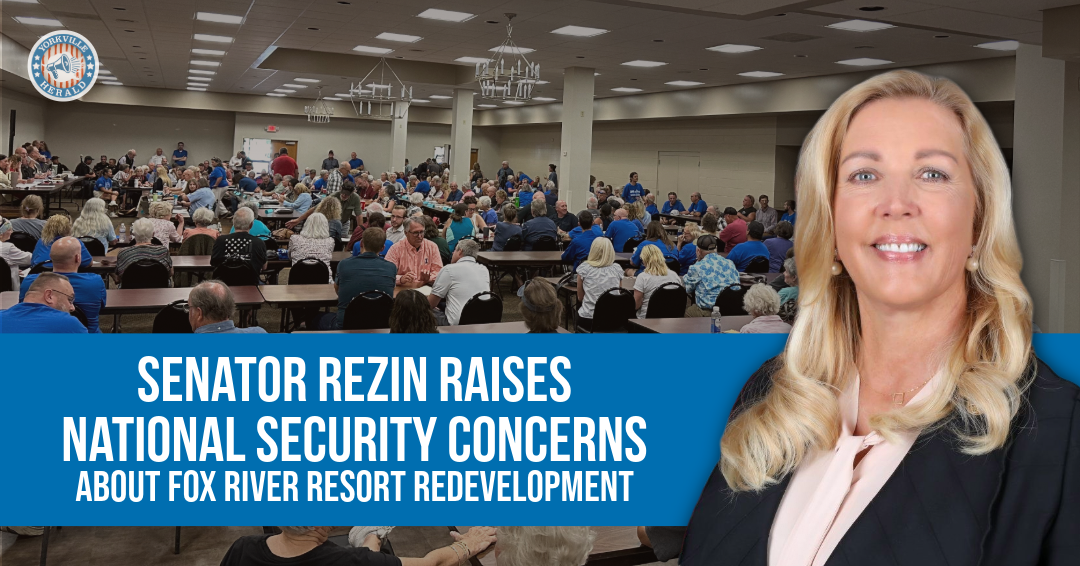
As a growing grassroots opposition movement packed the LaSalle County Board meeting Thursday, State Senator Sue Rezin, voiced concerns about both national security and local control issues tied to a proposal to redevelop the former Fox River Resort in Sheridan.
The meeting drew a strong showing from Defend LaSalle, a group opposing plans by real estate firm Vairt, which is marketing the project as "V Resort Living." The proposal would transform the roughly 165-acre property into what developers describe as a resort-style residential community with housing and other amenities.
The Fox River Resort site currently consists of approximately 332 units spread across more than 164 acres, along with a golf course, water park and recreational facilities. Promotional materials for the project envision a community centered on long-term residential living rather than the property's traditional hospitality and vacation resort use.
That distinction has become a central point of debate. Members of Defend LaSalle argue the plan would effectively create a high-density residential development in a rural area not designed to support that level of growth.
Rezin echoed those concerns during her remarks, arguing the proposal represents far more than the renovation of an existing resort property.
"This proposal is not simply about redeveloping a former resort," she said. "Their stated vision is to transform what was historically a temporary vacation and time share property into a permanent residential community that includes housing, a school, and a mosque."
A significant portion of her remarks focused on national security concerns. Rezin said a review of the proposed transaction was requested through the federal Committee on Foreign Investment in the United States (CFIUS) process because of the property's proximity to critical infrastructure.
"We've asked the Department of Justice under the CFIUS Act to review this transaction to ensure that the potential buyers or investors can legally purchase this property," Rezin said.
She added that federal officials have acknowledged the request.
"The Department of Justice has responded and they will be reviewing the facts, is my understanding," she said.
Rezin noted the property is located within 25 miles of the LaSalle Nuclear Power Plant and near the Illinois Army National Guard Training Center in Marseilles. She said state lawmakers have received briefings from homeland security officials regarding concerns over foreign-owned businesses and investors acquiring land near sensitive facilities and transportation infrastructure.
"I believe that developments of this magnitude, particularly those located near critical infrastructure, deserve careful review, complete transparency, and meaningful oversight before any decisions are made," Rezin said.
Rezin also warned against efforts in Springfield that could reduce local authority over development decisions. She criticized legislation being discussed as part of Governor JB Pritzker's housing agenda, arguing it could significantly limit local zoning oversight.
"It takes away your ability to decide, your local zoning board's ability to decide how you want to zone locally," she said.
Senator Rezin said she has "serious concerns" about the Fox River Resort proposal and does not believe it is "the right fit for this community."
She concluded by emphasizing that residents should retain a meaningful voice in determining the future of their communities.
"The people who will live with the consequences of this decision are sitting in the room today," Rezin said. "That's why your voices matter and that's why local zoning matters."
Many of the residents who addressed the County Board echoed Rezin's call for increased scrutiny, arguing that the proposal raises important questions about infrastructure, public safety, environmental stewardship, financial transparency and the future character of the region. Several speakers also framed their concerns around cultural, religious and civic identity (American identity), describing the debate as one that extends beyond land use and development to include the spiritual and constitutional foundation of America. While speakers approached the issue from different perspectives, most urged county officials to require extensive review, full public disclosure and meaningful public input before any redevelopment plans move forward.
Joseph Galvan, a LaSalle County resident and Digital Director at Fox River Church, urged officials to remain vigilant even if the current transaction does not move forward.
"While the developers have seemingly terminated the transaction due to earnest money issues and community pushback, the Board must remain vigilant and rigorously scrutinize any future applications for this property," Galvan said.
Galvan criticized changes made to the project's public messaging.
"Only after significant backlash did they soften or remove that language and claim the resort would welcome everyone," he said. "Pivoting after the fact doesn't earn trust, it exposes an agenda."
He called for extensive disclosure if any future approvals are sought.
"If any rezoning or approvals are ever sought, the Board must demand full public disclosure of ownership, operational plans, security arrangements, and all faith-based elements."
Cindy Fuller, a longtime resident and grandmother, urged officials to look beyond traditional zoning considerations and examine broader questions involving financing, governance and long-term community impact.
"I am speaking today because I believe decisions made now could affect my granddaughters and other families in this community for years to come," Fuller said.
Fuller referenced reporting published by the RAIR Foundation and publicly available videos and translations attributed to Vairt founder Jamil Ahmed Sukhera, urging county officials to carefully review the material and evaluate whether the proposal warrants scrutiny beyond a conventional zoning or housing review.
According to Fuller, statements attributed to Sukhera in the reporting raised questions about the project's broader purpose, funding structure and long-term intentions.
"The article states that Sukhera described the next phase as a 'war of the merchants' and discussed spreading influence through commerce rather than through armies," Fuller said.
She questioned whether residents have enough information about the project's funding sources and organizational structure.
"If the Illinois project is not expected to be financially profitable, local officials should clearly identify the project's funding sources, governance structure, and long-term community impact," she said.
Fuller emphasized that her concerns center on transparency and public accountability.
"The issue is not just whether the development is lawful, but whether the public has enough information to understand its full implications.
Michelle Peterson focused much of her comments on due diligence, ownership disclosures and potential national-security considerations.
"I am here because the proposed redevelopment of the Fox River Resort raises serious questions that deserve careful, transparent review before decisions are made that could permanently affect this community," Peterson said.
Peterson referenced publicly available marketing materials that she said raised questions about ownership and financing.
"Publicly available marketing materials, social media posts, and professional profiles associated with the project promoted fractional investment opportunities and advertised an open house before the transaction has publicly closed."
She also highlighted inquiries submitted to state and federal authorities.
"The federal government has recognized that certain foreign investments in American real estate may warrant national security review through the Committee on Foreign Investment in the United States, or CFIUS," Peterson said.
Calling for greater transparency, she added:
"Our citizens deserve honest answers before irreversible decisions are made."
Other speakers focused on cultural, religious and community-identity concerns.
Tim Hawley argued his opposition centered on cultural compatibility rather than development logistics.
"Our opposition does not ultimately rest on questions of motive," Hawley said.
He contended that the proposed community would be incompatible with local traditions and identity.
"America, LaSalle County, Mission Township, Sheridan, and Norway, Illinois ... are a particular place for our particular people with our particular ways."
Molly Krempski framed her remarks around what she described as the nation's spiritual and constitutional foundations, arguing that the debate over the Fox River Resort proposal extends beyond a single development project.
"This issue reaches far beyond Vairt or Fox River Resort. It's about the spiritual and constitutional foundation of America, the authority our laws rest upon, and whether we still have the courage to stand as One Nation Under God," Krempski told the Board.
Krempski argued that concerns about the proposed development should be considered within a broader discussion about faith, culture and civic identity, and said residents have sought reviews from state and federal agencies regarding foreign investment and regulatory matters.
"These theological issues become local issues when a proposed development raises serious questions about faith-centered separation, local accountability, and the long-term character of our community," she said.
She also urged public officials to support federal reviews of potential foreign investment concerns and ensure local zoning ordinances are enforced. Krempski concluded by asserting that America's institutions and liberties are rooted in Christian principles and that communities should be guided by those values when considering major development decisions.
Nicole Bouse, a Norway resident and conservation advocate, focused her comments on infrastructure capacity, environmental protection and the potential impact a large residential development could have on the area's historic and rural character.
Bouse argued the community is not equipped to accommodate the population growth promoted in project materials.
"Vairt has advertised ready-to-move-in turnkey apartments for up to 2,000 new residents. Our foremost objection is the lack of infrastructure to support this kind of development in this community composed of only 89 residents," Bouse said.
She raised concerns about increased traffic, emergency-service capacity and evacuation challenges, while urging officials to consider impacts on historic landmarks and neighboring communities.
Environmental preservation was also a major focus of her remarks. Bouse noted the property's location within a FEMA-designated floodplain along the Fox River and questioned how wildlife and sensitive habitats would be protected.
"As a conservationist and a steward of this good Earth who has lived on the Fox for 15 years, I would like to know how they will protect the wildlife when federal and local laws demand your actions preserve these protected and valuable species for generations to come," she said.
Bouse concluded by calling for greater transparency from developers and public officials.
"This community demands transparency and honest communication about this project," she said.
Throughout the meeting, speakers repeatedly returned to several common themes - local control, infrastructure capacity, environmental stewardship, transparency, ownership disclosure, and the need for federal scrutiny of any potential foreign investment connected to future redevelopment plans.
Beneath these concerns was a broader desire for a foundation grounded in truth, accountability, and faith. For many in attendance, that foundation ultimately rests in Jesus Christ, who is the enduring answer and the sure cornerstone upon which individuals, families, communities, and nations can build.
While the future of the Fox River Resort property remains uncertain, Thursday's strong turnout underscored the community's commitment to staying informed and engaged. Residents made clear that they intend to remain active participants in the process should any redevelopment proposal return for public review and consideration.
A tense exchange occurred later in the meeting when County Board member James Reid publicly challenged County Land Use Director Brian Gift over communications between his office and individuals connected to the proposed Fox River Resort redevelopment.
Reid cited a June 29th email to resident Cindy Fuller in which Gift stated that the county did not have "any specific documents" regarding her request and that no zoning applications or final determinations regarding use of the property had been submitted. Reid questioned that statement, pointing to a FOIA response containing approximately 51 pages of emails, maps, surveys, plats and other records exchanged between Gift, attorney Todd Melton and others associated with the property.
Gift responded that he had "actually never spoken with the actual buyer at all" and maintained that no formal zoning application had been filed. Defending his office's handling of the matter, Gift told the board, "My office is completely transparent," adding that he had provided "all my email exchanges with Mr. Melton, the buyer's attorney," along with documents, plans and subdivision records requested through the FOIA process.
The discussion grew increasingly contentious as Reid pressed Gift to explain the purpose of the communications and references in the emails to future development plans for the property. When asked to respond to specific documents, Gift said he wanted an opportunity to review the materials and questions before answering, stating, "Allow me to review your questions and the evidence that you've been presenting."
Reid rejected that response, arguing that the board and the public deserved answers regarding the communications. "I think the board has a right to get an answer on why these emails were sent out," Reid said. He later pointed to an email in which Gift referenced advertisements for apartments and the possible conversion of a building into a mosque, asking what had been discussed during a phone call referenced in the correspondence.
The exchange ended when Gift left the meeting room after indicating he was finished discussing the matter. Reid sharply criticized the decision, stating, "He walked out of the room and said, 'I'm done with this”’ and argued that county officials are accountable to both the board and county residents.
Following Gift's departure, Reid said he had "lost confidence" in the land use director and called for his resignation.