Sellers ask court to declare the purchase agreement terminated and rule that Vairt no longer has the right to acquire the Sheridan property
Sheridan IL | Yorkville Herald
Vairt Inc. publicly announced that it had “officially acquired” the former Fox River Resort and began promoting plans for apartments, fractional ownership, and a faith-centered resort community before the purchase was completed. Now, the entities selling the property are asking a court to declare that Vairt’s purchase agreement was terminated and that the company has no remaining right to acquire the Sheridan resort. Fox River Resort Club and Silverleaf Resorts, LLC filed the lawsuit July 6 in the Chancery Division of the Circuit Court of Cook County. The dispute concerns the former Fox River Resort at 2558 N. 3653rd Road near Sheridan, which Vairt promoted as the proposed home of “V Resort Living.”[1] The case provides the clearest public account to date of how the proposed sale unraveled. Exhibits filed with the complaint include emails, formal notices, and escrow correspondence documenting disagreements over Vairt’s marketing activities, an advertised open house, the return of earnest money, and whether the parties completed an agreement terminating the sale. The allegations have not been decided by the court, and Vairt will have the opportunity to dispute the sellers’ account.
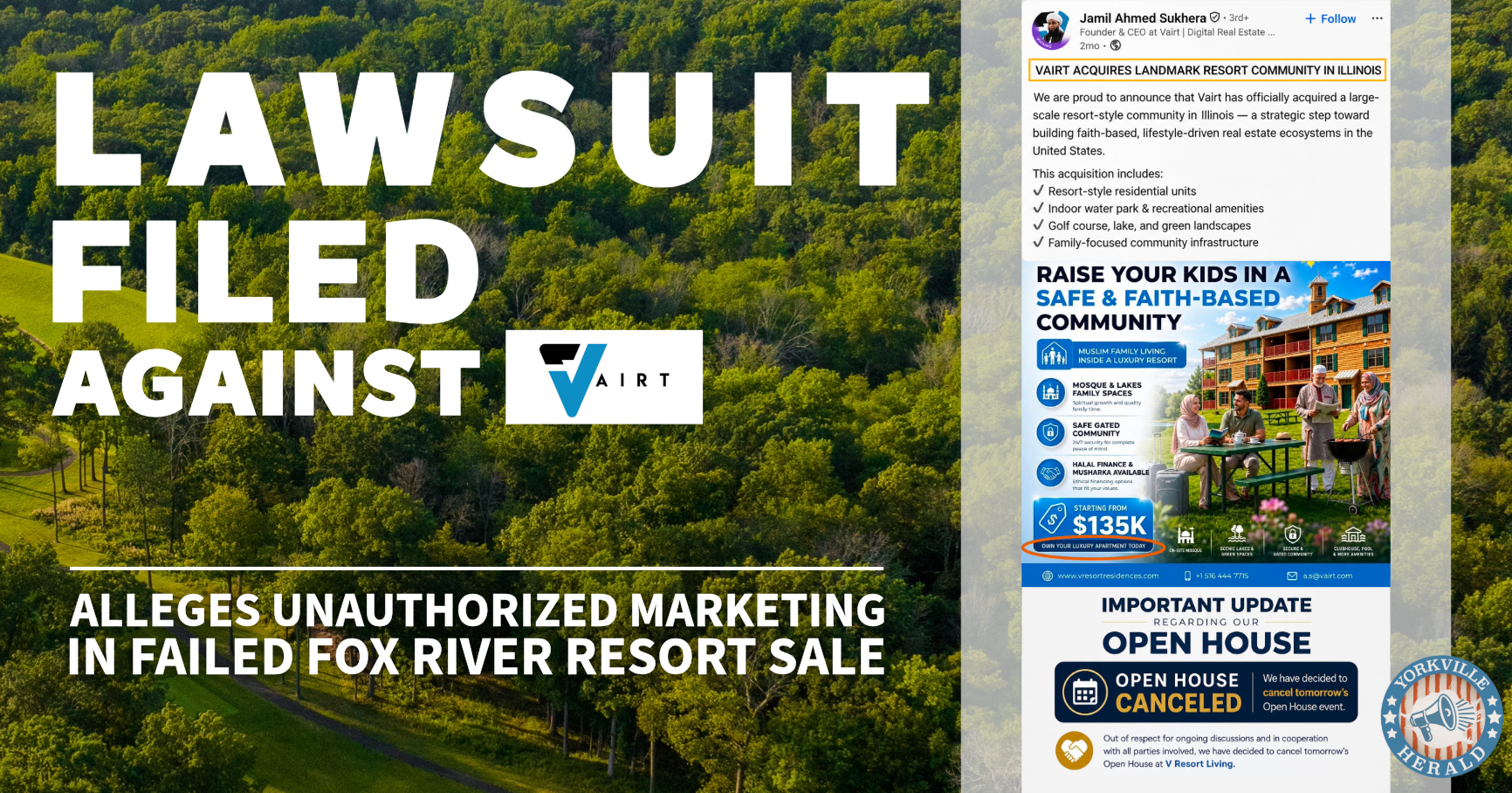
According to the lawsuit, Vairt entered into an agreement to purchase the resort on April 22. The transaction was originally expected to close in June. While the purchase remained pending, Vairt began publicly presenting detailed plans for the property. Its promotional materials described a gated, faith-centered resort community and advertised apartments, fractional ownership, resort amenities, halal dining, and a mosque. Other materials promoted a Musharakah co-ownership option described as being structured around Sharia- compliant principles. In one public LinkedIn post, Vairt CEO Jamil Ahmed Sukhera stated that Vairt had “officially acquired a large-scale resort-style community in Illinois.” The sellers now allege that Vairt did not own the property when those representations were made.
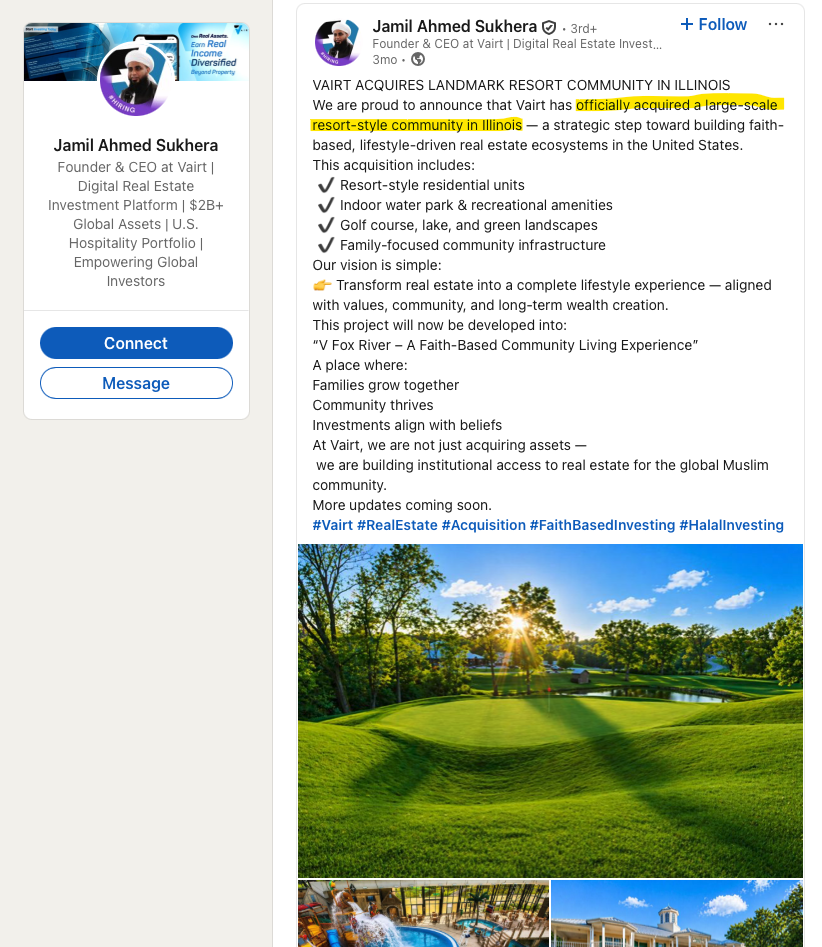
Sukhera, Jamil Ahmed. “VAIRT Acquires Landmark Resort Community in Illinois.” LinkedIn, 2025, [Screenshot by Yorkville Herald] https://www.linkedin.com/posts/jamil-ahmed-sukhera-202519392_vairt-realestate-acquisition-activity-7453058198694936576-2jtL. Accessed 23 July 2026. [linkedin.com]
On June 4, an attorney representing the sellers sent Sukhera a formal notice raising concerns about what the sellers described as unauthorized marketing and promotional conduct. The notice alleged that Vairt had “disseminated unauthorized advertisements and promotional materials through social media and other public channels” concerning its intended development and future use of the property.[2] The sellers said the advertising could create confusion about the resort’s ownership, operational control, and status. They further stated that they had not authorized Vairt’s promotional materials. The notice also objected to repeated tours involving Vairt representatives, business associates, and people who appeared to be prospective customers or future users of the proposed development. According to the sellers, Vairt’s access to the property was intended for legitimate due diligence, not “marketing, promotional, pre-sales, customer solicitation, or business development activities” before the sale closed.[3]
The sellers’ June 4 notice also addressed an event Vairt had reportedly planned at the resort. According to the notice, Vairt requested permission to conduct a property tour on June 7 with purported partners. Around the same time, the sellers became aware of advertisements promoting what appeared to be an open house scheduled for that date. “Seller has not authorized any open house, public event, marketing event, customer event, promotional event, or similar activity at the Property,” the notice stated.[4] The sellers directed Vairt to cancel the event and announce its cancellation through the same channels used to promote it. They also demanded that Vairt remove advertisements, social-media posts, and event listings suggesting that it already possessed authority to market, operate, or hold events at the resort. The marketing materials do not, by themselves, establish that Vairt breached the purchase agreement. That remains an allegation advanced by the sellers. The materials are nevertheless significant because they show what Vairt was publicly representing that it intended to develop at the property before the proposed acquisition was completed.
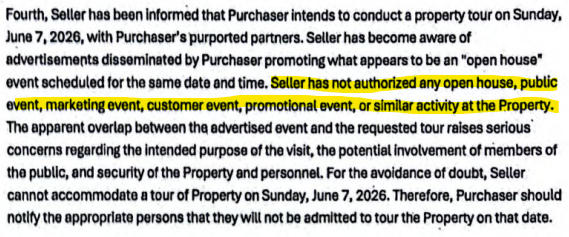
June 4 notice concerning the advertised open house, PDF pp. 61-62.
The complaint states that additional disagreements followed and that Vairt eventually indicated it would not proceed with the purchase. The parties then began negotiating a mutual termination and release agreement while working with Wheatland Title to arrange the return of Vairt’s earnest-money deposit. The sellers say they signed the termination agreement on June 18. The following day, an attorney representing Vairt wrote in an email, “My client signed everything.” The attorney added that the documents could be released after the title company confirmed that the proposed form would work.[5] The sellers cite that email as evidence that Vairt signed and accepted the termination agreement. Additional correspondence cited by the sellers indicates that both sides initially treated the sale as terminated. In a June 24 letter, Vairt itself referred to the “Mutual Termination and Release Agreement executed on June 18, 2026.” The letter also stated that the parties had agreed to terminate the purchase agreement and return the earnest money held in escrow.[6]
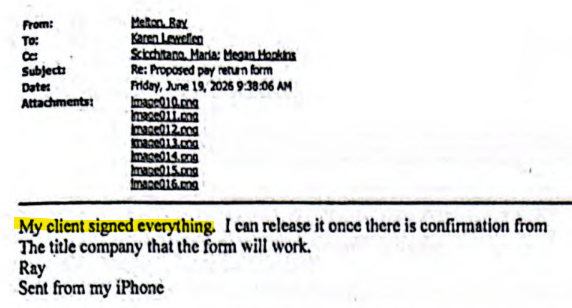
June 19 email from Vairt’s attorney, PDF p. 74.
According to the complaint, most of Vairt’s earnest money was returned. A portion of the deposit, however, had reportedly been provided by third parties. The escrow agent requested documentation establishing Vairt’s authority to direct where those funds should be sent or confirmation from the third-party depositors. The sellers allege that Vairt then reversed its position rather than providing the requested documentation. Vairt proposed that the parties rescind the termination process and extend the closing date by 60 days if the remaining funds were not immediately released.[7] The sellers contend that Vairt later asserted that the termination agreement was unenforceable because its executed signature page had not been delivered to them. The sellers dispute that argument. They maintain that delivery of the signature page was not a condition of the agreement and that Vairt’s emails, written statements, demand for the return of its deposit, and acceptance of most of the returned funds demonstrate that it agreed to terminate the transaction.

Vairt’s proposed 60-day extension, PDF p. 81.
The court has not decided which interpretation is correct. The sellers are asking the court to declare that the termination agreement is valid, that the original purchase agreement is no longer in effect, and that Vairt has no remaining contractual right to acquire the resort. They have also asked the court to consider the matter on an expedited schedule.
In their filing, the sellers claim that operating, maintaining, and carrying the unsold property costs approximately $300,000 each month. They argue that Vairt’s continuing assertion of rights in the property interferes with their ability to market or sell it to another buyer.[8]
The immediate legal question is narrow: whether the agreement to terminate the sale is enforceable. The lawsuit does not presently ask the court to determine whether Vairt’s proposed development would comply with zoning, land-use, securities, financing, or other applicable laws. It also does not ask the court to evaluate the proposed community’s religious character or ownership structure.
Its outcome may nevertheless determine whether Vairt can continue pursuing V Resort Living at the former Fox River Resort, or whether the Sheridan property will be placed back on the market.
Vairt was contacted for comment on 7-21-26, and given until 7-24-26 (12 p.m.) to respond. Vairt did not respond before the publication deadline.
Endnotes
[1] Verified Complaint for Declaratory Judgment, Fox River Resort Club and Silverleaf Resorts, LLC v. Vairt Inc., Cook County Case No. 2026 CH 06461, PDF pp. 23-30.
[2] June 4 notice concerning advertisements and promotional materials, PDF pp. 60-61.
[3] June 4 notice concerning tours, access rights, and alleged promotional activities, PDF p. 60.
[4] June 4 notice concerning the advertised open house, PDF pp. 61-62.
[5] June 19 email from Vairt’s attorney stating, “My client signed everything,” PDF p. 74.
[6] Vairt’s June 24 correspondence referring to the executed termination agreement, PDF p. 80.
[7] Vairt’s proposed 60-day extension, PDF p. 81.
[8] Plaintiffs’ motion for an early hearing and claimed monthly operating and carrying expenses, PDF p. 16.
Primary source: The 121-page filing containing the complaint, motions, correspondence, and exhibits.